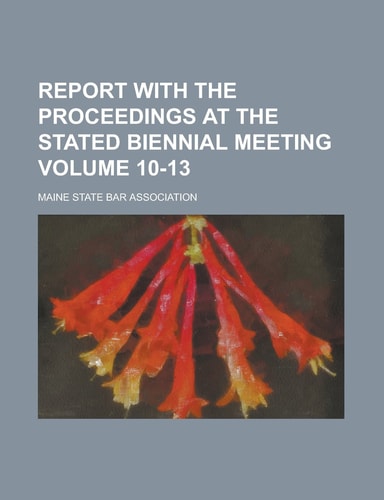
Report with the Proceedings at the Stated Biennial Meeting, Volume 10-13
0
0
As an Amazon Associate and affiliate partner, Menrva Books earns from qualifying purchases. Learn more
Author Description
This historic book may have numerous typos and missing text. Purchasers can usually download a free scanned copy of the original book (without typos) from the publisher. Not indexed. Not illustrated. 1901 edition. Excerpt:... most enlightened sentiment of their constituency, we may safely bid defiance to all other dangers." As to corporate property, there can be no such thing except under legislative act. A corporation can only exist by charter, general or special, and a limitation upon its power to hold property is always provided, a limitation which it cannot exceed if the state sees fit to interfere. If the tremendous doctrine which the eloquence of Webster vindicated, and the learning of Chief Justice Marshall established, in the Dartmouth College case, that a corporate charter is a contract between the corporation and the state, which the state has no power to change, had prevailed in its full scope, and corporations been created under it with the frequency of modern instances, the substance of power in this respect might have passed from the states to the corporations themselves, with their immense aggregations of wealth and influence, wholly removed from governmental control. But comparatively few corporations exist which are not, either by the express terms of their charters or by general provisions of law under which they were established, made subject to the action of the legislature even to the extent of wholly changing or repealing their charters. So far as the corporate character of their accumulations of property is concerned, it is as a rule wholly subject theoretically to the exercise of legislative authority. VVhen we consider further the extent of the power exercised by the legislature in the regulation of the enjoyment of rights of property by what is known as the police power, based upon the principle that all property in the state is held subject to those general regulations which are necessary to the common good and general...
Menrva's Summary
THE THESIS
This volume documents the proceedings of the Maine State Bar Association's biennial meetings, focusing on legal discourse and the evolving landscape of corporate law and property rights in the early 20th century. Through the transcribed discussions and reports from the Stated Biennial Meetings, the book examines the historical context of corporate charters, legislative authority over corporations, and the implications of landmark legal decisions like the Dartmouth College case. It delves into the concept of the 'police power' of the state as it relates to the regulation of property rights for the common good, reflecting the legal thinking and debates of the era.
THE SCOPE MAP
- Transcripts of discussions from the Maine State Bar Association's biennial meetings (Volumes 10-13).
- Analysis of early 20th-century legal perspectives on corporate law and property.
- Examination of the historical significance of the Dartmouth College case and its impact on corporate charters.
- Discussion of the state's 'police power' in regulating property rights for public welfare.
- Historical context of legal thought regarding legislative control over corporate entities.
THE AUTHORITY PERSPECTIVE
This book serves as a primary source document for understanding legal discussions and concerns surrounding corporate law and property rights in Maine at the turn of the 20th century. The provided description indicates that the original text may contain errors, with a scanned copy available from the publisher. The content appears to be a direct transcription of historical legal proceedings, offering insight into the legal reasoning and debates of the period.
Page Count:
32
Publication Date:
2013-09-13
Publisher:
RareBooksClub.com
ISBN-10:
1236762401
ISBN-13:
9781236762405
History
Non-Fiction
Legal History
Law
Community Tags
Similar Books