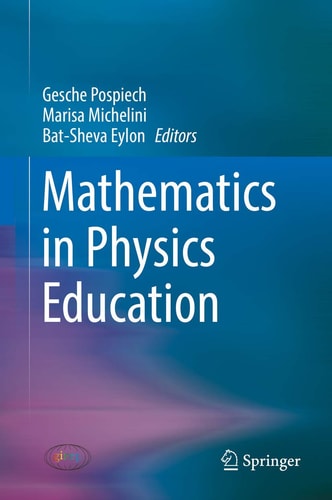
Mathematics in Physics Education
0
0
As an Amazon Associate and affiliate partner, Menrva Books earns from qualifying purchases. Learn more
Author Description
This book is about mathematics in physics education, the difficulties students have in learning physics, and the way in which mathematization can help to improve physics teaching and learning. The book brings together different teaching and learning perspectives, and addresses both fundamental considerations and practical aspects. Divided into four parts, the book starts out with theoretical viewpoints that enlighten the interplay of physics and mathematics also including historical developments. The second part delves into the learners’ perspective. It addresses aspects of the learning by secondary school students as well as by students just entering university, or teacher students. Topics discussed range from problem solving over the role of graphs to integrated mathematics and physics learning. The third part includes a broad range of subjects from teachers’ views and knowledge, the analysis of classroom discourse and an evaluated teaching proposal. The last part describes approaches that take up mathematization in a broader interpretation, and includes the presentation of a model for physics teachers’ pedagogical content knowledge (PCK) specific to the role of mathematics in physics.
Menrva's Summary
THE THESIS
This book investigates the critical role of mathematics in physics education and explores strategies to enhance student learning. It addresses the challenges students face in grasping physics concepts, particularly when mathematical formalisms are involved, and proposes how mathematization can serve as a pedagogical tool. The work synthesizes theoretical viewpoints, historical context, and practical classroom applications, drawing on research concerning secondary school students, university entrants, and teacher trainees.
THE SCOPE MAP
- Theoretical viewpoints on the interplay of physics and mathematics, including historical developments.
- Learners' perspectives on physics and mathematics learning, covering secondary school, university, and teacher students.
- Analysis of problem-solving, the role of graphs, and integrated mathematics and physics learning.
- Teachers' views and knowledge regarding mathematics in physics education.
- Classroom discourse analysis and evaluated teaching proposals.
- Approaches to mathematization in a broader interpretation.
- A model for physics teachers' pedagogical content knowledge (PCK) specific to mathematics in physics.
THE AUTHORITY PERSPECTIVE
The book is structured to provide a comprehensive overview of mathematics in physics education, moving from theoretical underpinnings to practical classroom implementation. It aims to bridge the gap between mathematical understanding and physics comprehension for students and educators alike. The inclusion of diverse perspectives, from learners to teachers, suggests a thorough examination of the subject. The detailed breakdown into four parts indicates a systematic approach to addressing the complexities of mathematization in physics pedagogy.
Page Count:
385
Publication Date:
2019-07-12
Publisher:
Springer International Publishing
ISBN-10:
3030046265
ISBN-13:
9783030046262
Science
Non-Fiction
Self-help
Pedagogy
Physics
Mathematics
Education
Community Tags
Other Editions(2)
Similar Books