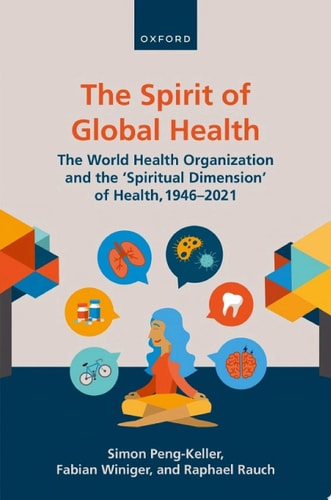
The Spirit of Global Health: The World Health Organization and the 'Spiritual Dimension' of Health, 1946-2021
0
0
As an Amazon Associate and affiliate partner, Menrva Books earns from qualifying purchases. Learn more
Author Description
Since the beginning of the World Health Organization, many of its staff members, regional offices, member states, and directors-general have grappled with the question of what a 'spiritual dimension' of health looks like, and how it might enrich the health policies advocated by their organisations. Contrary to the wide-spread perception that 'spirituality' is primarily related to palliative care and has emerged relatively recently within the organisation, this study shows that its history is considerably longer and more complex, and has been closely connected to the WHO's ethical aspirations, its quest for more holistic and equitable healthcare, and its struggle with the colonial legacy of international health organisations. While such ideals and struggles silently motivated many of the key actors and policies - such as the provision of universal primary healthcare - which for decades have embodied the organisation's loftiest aspirations, the WHO's official relationship with 'spirituality' advanced in fits, leaps, and setbacks. At times creative and interdisciplinary, at others deeply political, this process was marked by cycles of institutional forgetting and remembering. Rather than as a triumph of religious lobbyists, this book argues, the 'spiritual dimension' of health may be better understood as a 'ghost' that has haunted - and continues to haunt - the WHO as it comes to terms with its mandate of advancing health as a state of 'complete well-being' available to all.
Menrva's Summary
THE THESIS
This book investigates how the World Health Organization has navigated the concept of a 'spiritual dimension' of health throughout its history from 1946 to 2021. Simon Peng-Keller, a scholar of theology and health, utilizes archival research and institutional records to demonstrate that spirituality has been a persistent, if often overlooked, factor in the organization's pursuit of holistic healthcare. The author argues that this dimension is deeply intertwined with the WHO's ethical aspirations and its ongoing efforts to address the colonial legacy of international health governance.
THE SCOPE MAP
What You Will Find
- Historical analysis of WHO policy development from 1946 to 2021
- Examination of the tension between secular health mandates and spiritual well-being
- Case studies on the integration of holistic health ideals into primary healthcare initiatives
Scope Limits
- Does not provide a clinical or medical definition of spirituality
- Does not focus on the specific religious practices of individual member states
THE AUTHORITY PERSPECTIVE
Experts recognize this work as a significant contribution to the history of international health organizations, noting its ability to bridge the gap between medical policy and theological inquiry. Readers frequently highlight the author's meticulous archival approach in uncovering the 'ghost' of spirituality within institutional memory.
Page Count:
264
Publication Date:
2022-01-01
Publisher:
OUP Oxford
ISBN-10:
019268924X
ISBN-13:
9780192689245
Religion
History
Medical Ethics
Public Health
International relations
Sociology of Religion
Community Tags
Similar Books