Flash Math Creativity
0
0
As an Amazon Associate and affiliate partner, Menrva Books earns from qualifying purchases. Learn more
Author Description
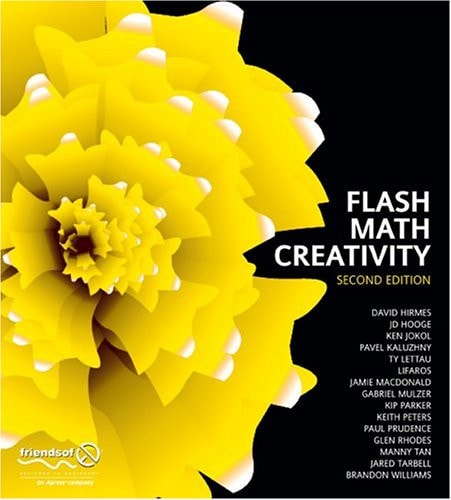
The seminal book, Flash Math Creativity, completely revised for Flash MX 2004 and ActionScript 2.0! Macromedia Flash is the industry standard design tool for digital design and web programming. With the release of Flash MX 2004 and its accompanying built-in language ActionScript 2.0, Macromedia yet again upped the standard for creating immersive digital experiences. This book revolves around Flash and math. It's what you do in your spare time: just take little ideas and mess around with them. This is a book of inspiration, beautiful enough to leave on the coffee table, but addictive enough to keep by your computer and sneak out while no-one's looking so you can go back to that movie that you were tinkering with 'til 3 o'clock this morning. It's a fun book! Flash Math Creativity is a book of iterative experiments generative design. It's a showcase of the 15 authors' experiments. The book will explain how these work and how you to can experiment further yourself. Each author does four experiments; each experiment takes up four pages. We give you the code and explain the essence, then you take away your inspiration and run with it. The purpose of the book is to learn through experimentation because you are inspired to do so, not because someone is telling you to do so.
Menrva's Summary
THE THESIS
This book explores the intersection of mathematics, programming, and creative design through iterative experiments. It is a revised edition for Flash MX 2004 and ActionScript 2.0, focusing on generative design principles. The book showcases 15 authors' experiments, providing code and explanations to inspire readers to further explore and create their own digital experiences. The core philosophy is learning through self-directed experimentation driven by inspiration rather than instruction.
THE SCOPE MAP
- Exploration of mathematical concepts applied to digital design.
- Detailed explanations and code for 15 authors' generative design experiments.
- Focus on Flash MX 2004 and ActionScript 2.0.
- Techniques for creating immersive digital experiences.
- Inspirational examples for coffee table display and practical application.
- Guidance on further experimentation and personal creative development.
THE AUTHORITY PERSPECTIVE
This book is presented as a seminal work, revised to incorporate the latest technologies in Flash development. The emphasis is on inspiration and hands-on experimentation, making it suitable for both casual browsing and active learning. The structure, with four pages dedicated to each of the 60 experiments, suggests a visually engaging and detailed approach. The goal is to foster a creative environment where users are motivated to learn through their own exploration of the provided code and concepts.
Page Count:
264
Publication Date:
2004-12-16
Publisher:
Apress
ISBN-10:
1590594290
ISBN-13:
9781590594292
Science & Technology
Art
Non-Fiction
Programming
Design
Inspiration
Community Tags
Similar Books