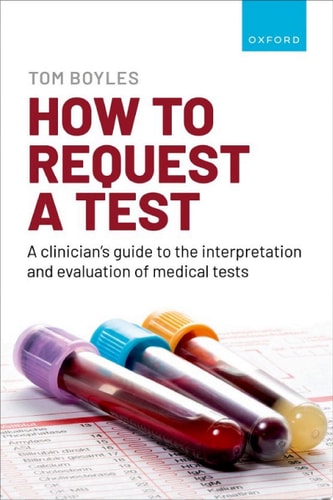
How to Request a Test: A Clinician's Guide to the Interpretation and Evaluation of Medical Tests
0
0
As an Amazon Associate and affiliate partner, Menrva Books earns from qualifying purchases. Learn more
Author Description
Medical tests consume considerable resources and yet making requests is often left to the most junior members of the team. Medical schools often under prepare junior doctors for these tasks so they tend to request large numbers of tests to make sure 'all bases are covered' by the time a more senior colleague attends to the patient. Beginning with naïve questions such as 'what is a medical test?' and 'why do we perform tests?', the book also covers the evaluation of tests from a public health perspective and helps the readers to determine whether a test should be introduced into clinical care. By describing the basics of medical decision making based on probability thresholds, students will learn how to avoid unnecessary testing when results are unlikely to influence patient relevant decisions, and the pros and cons of using metrics such as sensitivity, specificity, and predictive values. Illustrated throughout with real life examples from multiple medical and surgical specialties, it concludes with a novel checklist for doctors to consider every time they think of requesting a test. Written by a clinician for clinicians, this book is ideal for medical students and junior doctors. It provides everything they need to know to become experts at requesting tests. It will support them in requesting the most appropriate and effective tests, and inform them on how to interpret results, improving patients' outcomes.
Menrva's Summary
THE THESIS
This book investigates the clinical decision-making process behind medical testing to determine how practitioners can optimize diagnostic accuracy while minimizing unnecessary resource consumption. Author Tom Boyles, a practicing clinician, addresses the systemic gap in medical education where junior staff are often tasked with ordering tests without adequate training. He presents a framework centered on probability thresholds and diagnostic metrics to guide clinicians in making evidence-based decisions that directly influence patient outcomes.
THE SCOPE MAP
What You Will Find
- Fundamental definitions of medical tests and their clinical utility
- Analysis of sensitivity, specificity, and predictive values
- A novel checklist for evaluating the necessity of a test before ordering
- Real-life examples across various medical and surgical specialties
Scope Limits
- Does not provide an exhaustive encyclopedia of every specific medical test
- Does not cover administrative billing or hospital-specific procurement policies
THE AUTHORITY PERSPECTIVE
Clinicians and medical educators frequently highlight this text as a practical, high-utility resource for junior doctors navigating the complexities of diagnostic ordering. Experts note that the book successfully bridges the gap between theoretical statistics and the daily realities of clinical practice.
Page Count:
336
Publication Date:
2022-01-01
Publisher:
OUP Oxford
ISBN-10:
0192691848
ISBN-13:
9780192691842
Medical Education
Allied Health
Health Professions
Medical
Professional Development