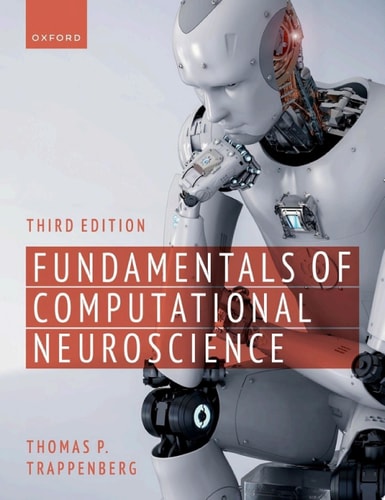
Fundamentals of Computational Neuroscience
0
0
As an Amazon Associate and affiliate partner, Menrva Books earns from qualifying purchases. Learn more
Author Description
Computational neuroscience is the theoretical study of the brain to uncover the principles and mechanisms that guide the development, organization, information processing, and mental functions of the nervous system. Although not a new area, it is only recently that enough knowledge has been gathered to establish computational neuroscience as a scientific discipline in its own right. Given the complexity of the field, and its increasing importance in progressing our understanding of how the brain works, there has long been a need for an introductory text on what is often assumed to be an impenetrable topic.The new edition of Fundamentals of Computational Neuroscience build on the success and strengths of the previous editions. It introduces the theoretical foundations of neuroscience with a focus on the nature of information processing in the brain. The book covers the introduction and motivation of simplified models of neurons that are suitable for exploring information processing in large brain-like networks. Additionally, it introduces several fundamental network architectures and discusses their relevance for information processing in the brain, giving some examples of models of higher-order cognitive functions to demonstrate the advanced insight that can be gained with such studies.Each chapter starts by introducing its topic with experimental facts and conceptual questions related to the study of brain function. An additional feature is the inclusion of simple Matlab programs that can be used to explore many of the mechanisms explained in the book. An accompanying webpage includes programs for download. The book will be the essential text for anyone in the brain sciences who wants to get to grips with this topic.
Menrva's Summary
THE THESIS
This text investigates the core principles and mathematical mechanisms that govern information processing within the nervous system. Author Thomas P. Trappenberg, a researcher in the field, provides a structured framework for understanding brain function through simplified modeling. The book synthesizes experimental biological data with computational theory to bridge the gap between neurobiology and network architecture.
THE SCOPE MAP
What You Will Find
- Mathematical models of individual neurons and their information processing capabilities
- Analysis of fundamental network architectures and their cognitive relevance
- Practical implementation exercises using Matlab programming
- Conceptual questions linking experimental facts to theoretical models
Scope Limits
- Does not cover advanced clinical neurology or surgical applications
- Does not provide an exhaustive survey of every existing neural network algorithm
THE AUTHORITY PERSPECTIVE
Experts and students frequently identify this work as a foundational introductory text for those entering the brain sciences. Readers often note the balance between theoretical rigor and the accessibility provided by the included computational exercises.
Page Count:
336
Publication Date:
2022-01-01
Publisher:
OUP Oxford
ISBN-10:
0192696130
ISBN-13:
9780192696137
Science
Mathematics
Neuroscience
Medical
textbook
Allied Health
Community Tags
Other Editions(3)
Similar Books













Reader Comments
Share Your Thoughts
No comments yet. Be the first to share your thoughts!