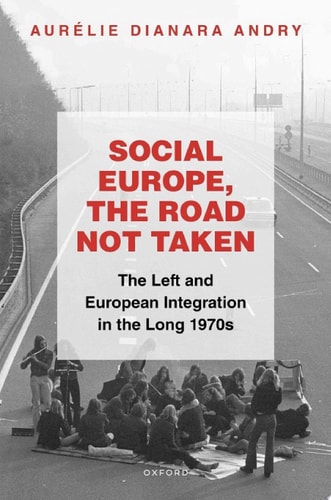
Social Europe, the Road Not Taken: The Left and European Integration in the Long 1970s
0
0
As an Amazon Associate and affiliate partner, Menrva Books earns from qualifying purchases. Learn more
Author Description
This book examines the European Left's attempt to think and give shape to an alternative type of European integration-a 'social Europe'-during the long 1970s.Based on fresh archival material, it shows that the western European Left-in particular social democratic parties, trade unions, and to a lesser extent 'Eurocommunist' parties-formulated a project to turn 'capitalist Europe' into a 'workers' Europe'. This project favoured coordinated measures for wealth redistribution, market regulation, a democratisation of the economy and of European institutions, upward harmonisation of social and fiscal systems, more inclusive welfare regimes, guaranteed employment, economic and social planning with greater consideration for the environment, increased public spending to meet collective needs, greater control of capital flows and multinational corporations, a reduction in working time, and a fairer international economic order favouring the global south. During the pivotal years following 1968, deeply marked by labour militancy, new social movements, economic crisis, and the unmaking of the 'postwar compromise', a window of opportunity opened in which European integration could have taken different roads. The defeat of 'social Europe' was a result of a decade-long social conflict which ended with the affirmation of a neoliberal Europe.Investigating this forgotten struggle and the reasons of its defeat can be useful not just to scholars and students eager to understand the historical evolution of European integration, the European Left, and European capitalism, but also to anyone interested in building alternative European and global futures.
Menrva's Summary
THE THESIS
This book investigates why the European Left failed to implement a 'social Europe' model during the 1970s, ultimately leading to the dominance of neoliberal integration. Aurélie Dianara Andry, a historian specializing in modern European politics, utilizes extensive archival research to reconstruct the strategic efforts of social democratic parties, trade unions, and Eurocommunist factions. The work argues that the defeat of this alternative vision was not inevitable but the result of intense social conflict and the collapse of the postwar economic compromise.
THE SCOPE MAP
What You Will Find
- Analysis of policy proposals for wealth redistribution and market regulation during the 1970s
- Examination of the role of labor militancy and new social movements in shaping political discourse
- Historical context regarding the transition from postwar social democracy to neoliberalism
Scope Limits
- The study focuses primarily on Western European actors rather than a comprehensive analysis of Eastern Bloc perspectives
- The narrative concludes at the end of the 1970s, leaving subsequent developments in European integration outside the primary scope
THE AUTHORITY PERSPECTIVE
Scholars in the field of modern European history recognize this work as a significant contribution to understanding the ideological shifts of the late twentieth century. Readers frequently note the academic density of the prose and the depth of the archival evidence provided to support the author's historical claims.
Page Count:
332
Publication Date:
2022-01-01
Publisher:
OUP Oxford
ISBN-10:
0192692690
ISBN-13:
9780192692696
Economics
History
Labor history
Socialism
European History
Community Tags
Similar Books