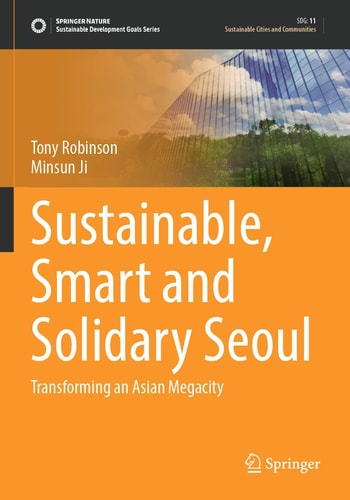
Sustainable, Smart and Solidary Seoul: Transforming an Asian Megacity
0
0
As an Amazon Associate and affiliate partner, Menrva Books earns from qualifying purchases. Learn more
Author Description
This book showcases how innovative state policy in Korea transformed Seoul from one of the world’s most impoverished, polluted, and congested cities into a global leader in green urban planning, smart city innovations, and social economy initiatives that have dramatically improved the local quality of life. Today, Seoul’s urban planning innovations are increasingly touted as replicable best practices for export to cities across the globe. This book describes how innovative state policy has made Seoul a world leader in sustainable, smart, and solidary urban initiatives. Beginning in the 1960s, Seoul led the fastest urbanization and modernization project in world history, becoming a colossal 26-million-person metropolitan region and one of the largest footprints of humanity on earth, transforming the nation from one of the world’s poorest to having the 10th largest GDP in 2020. Today, Seoul has become one of the most productive and innovative urban agglomerations onearth. Seoul’s residents enjoy the world’s highest penetration of high-speed internet, a model mass transit system, and advanced smart-city technologies. The vast city has become increasingly green and sustainable, while also recycling about 90% of all waste. Seoul has become a leader in social economy innovations like cooperative villages, mutual benefit societies, and social investment funds that advance equitable development goals amid a booming capitalist economy. To broaden our imagination of what good urbanism can achieve, this book reviews Seoul’s recent innovations in smart, sustainable, and solidary urbanism, including: green urban planning, sustainable development through recycling and reuse, well-managed mass transit, smart city design, and solidarity economy initiatives.
Menrva's Summary
THE THESIS
This book investigates how innovative state policy in Korea transformed Seoul into a global leader in urban development. It details Seoul's rapid modernization from a post-war impoverished city to a 26-million-person metropolis, highlighting its advancements in green urban planning, smart city technologies, and social economy initiatives that have significantly improved residents' quality of life. The authors examine the period beginning in the 1960s, tracing Seoul's journey to becoming one of the world's most productive and innovative urban agglomerations, with a high GDP and advanced infrastructure.
THE SCOPE MAP
- Green urban planning strategies and their impact on sustainability.
- Sustainable development through comprehensive recycling and reuse programs.
- Analysis of Seoul's model mass transit system and its efficiency.
- Overview of smart city design and the integration of advanced technologies.
- Exploration of solidarity economy initiatives, including cooperative villages and social investment funds.
- The historical context of Seoul's rapid urbanization and modernization since the 1960s.
- Seoul's transformation into a global leader in urban innovation and quality of life.
THE AUTHORITY PERSPECTIVE
The book presents Seoul's urban innovations as replicable best practices for cities worldwide, focusing on how state policy has driven advancements in sustainability, smart city development, and social solidarity. It highlights Seoul's remarkable transformation from a heavily polluted and congested city to a model of urban excellence, characterized by high-speed internet penetration, efficient public transport, and a high waste recycling rate. The authors also detail the city's leadership in social economy innovations aimed at equitable development within a capitalist framework. The work aims to broaden understanding of what effective urbanism can achieve through these case studies.
Page Count:
175
Publication Date:
2023-10-02
Publisher:
Springer International Publishing
ISBN-10:
3031135970
ISBN-13:
9783031135972
Non-Fiction
History
Politics
Public Policy
urban planning
Smart Cities
Sustainability
Korean Studies
Community Tags
Similar Books