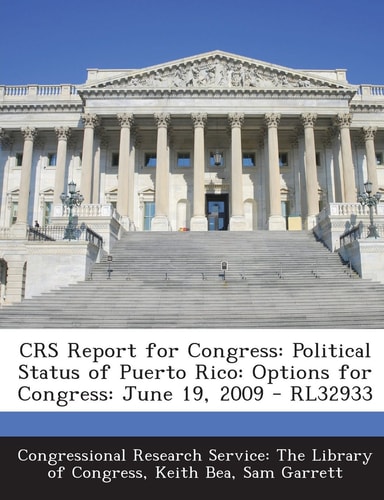
CRS Report for Congress: Political Status of Puerto Rico: Options for Congress: June 19, 2009
0
0
As an Amazon Associate and affiliate partner, Menrva Books earns from qualifying purchases. Learn more
Author Description
The United States acquired the islands of Puerto Rico in 1898 after the Spanish-American War. In 1950, Congress enacted legislation (P.L. 81-600) authorizing Puerto Rico to hold a constitutional convention and in 1952, the people of Puerto Rico ratified a constitution establishing a republican form of government for the islands. After being approved by Congress and the President in July 1952 and thus given force under federal law (P.L. 82-447), the new constitution went into effect on July 25, 1952. Puerto Rico is subject to congressional jurisdiction under the Territorial Clause of the U.S. Constitution. Over the past century, Congress passed legislation governing Puerto Ricos relationship with the United States. For example, residents of Puerto Rico hold U.S. citizenship, serve in the military, are subject to federal laws, and are represented in the House of Representatives by a Resident Commissioner elected to a four-year term. Although residents participate in the presidential nominating process, they do not vote in the general election. Puerto Ricans pay federal tax on income derived from sources in the United States, but they pay no federal tax on income earned in Puerto Rico. In the 111th Congress, the Resident Commissioner may vote in legislative committees and...
Menrva's Summary
THE THESIS
This report examines the complex political status of Puerto Rico and the various options available to the U.S. Congress for resolving its relationship with the island. Authored by Keith Bea and Sam Garrett, this Congressional Research Service (CRS) report details the historical evolution of Puerto Rico's status since the Spanish-American War, including key legislative milestones such as the authorization for a constitutional convention and the subsequent ratification of a republican form of government. It outlines Puerto Rico's current relationship with the United States under the Territorial Clause of the Constitution, highlighting aspects like U.S. citizenship for residents, military service, federal law applicability, and representation in the House, while also noting limitations such as the inability to vote in general presidential elections. The report further clarifies the tax implications for Puerto Rican residents and income earned within the island.
THE SCOPE MAP
- Historical overview of U.S. acquisition of Puerto Rico and subsequent governance.
- Analysis of key legislation shaping Puerto Rico's political status, including P.L. 81-600 and P.L. 82-447.
- Explanation of Puerto Rico's current constitutional framework and republican form of government.
- Details on the application of the Territorial Clause of the U.S. Constitution to Puerto Rico.
- Examination of rights and responsibilities of Puerto Rican residents, including U.S. citizenship and military service.
- Discussion of Puerto Rico's representation in the U.S. House of Representatives and presidential election participation.
- Clarification of federal tax policies affecting income earned by Puerto Rican residents.
THE AUTHORITY PERSPECTIVE
This report is a factual overview intended to inform congressional deliberations on Puerto Rico's political status. It presents historical context and legal frameworks without advocating for a particular outcome. The document's strength lies in its detailed account of legislative actions and the current legal standing of the island. It serves as a reference for understanding the complexities of the U.S.-Puerto Rico relationship from a governmental perspective.
Page Count:
56
Publication Date:
2013-09-26
Publisher:
BiblioGov
ISBN-10:
128769618X
ISBN-13:
9781287696186
Politics
History
Non-Fiction
Law
Community Tags
Similar Books