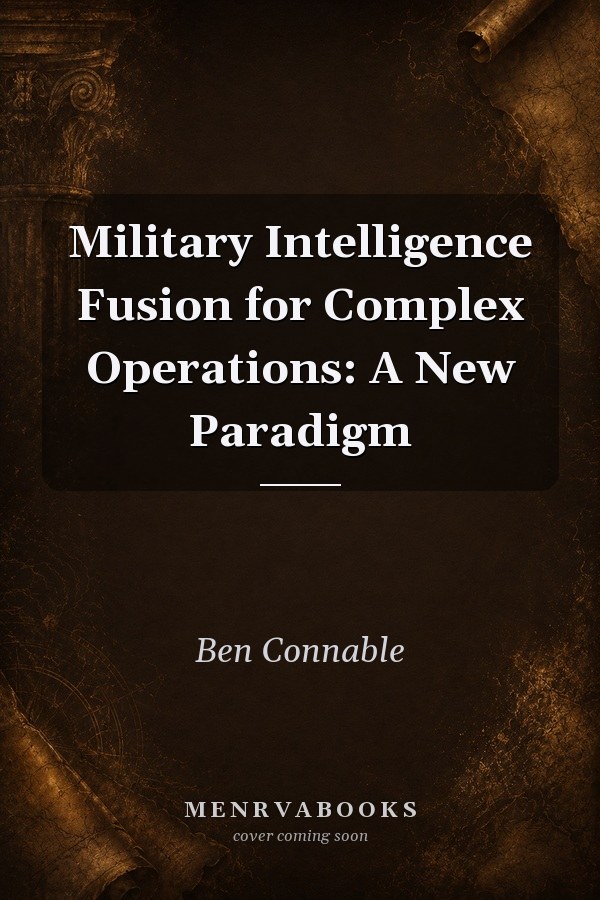
Military Intelligence Fusion for Complex Operations: A New Paradigm
0
0
As an Amazon Associate and affiliate partner, Menrva Books earns from qualifying purchases. Learn more
Author Description
In the hostile, complex, and chaotic counterinsurgency environment, people can support the government and the insurgency to varying degrees at the same time -- and be similarly resentful of both. Identifying all but the unequivocally irredeemable as an "enemy" and labeling anyone wearing a government uniform as a "friend" not only creates a false paradigm of human identity, but it also artificially bounds the U.S. military's options for influencing a population during a counterinsurgency operation. Analyzing complex environments, such as Iraq or Afghanistan, through simplified approaches that incorporate color-coding and enforce a strict division of analytic specialties can lead analysts to make unhelpful and logically unsound assumptions about human identity. Color-coded, enemy-centric analyses also reinforce the inaccurate and unhelpful notion that the enemy and society are separate constructs in the counterinsurgency environment, or separate subsystems (or groups) within a larger societal system. On the contrary, what is needed is an all-source, holistic, fused approach to analysis that takes into account sociocultural ambiguities. This paper proposes a paradigm shift in how intelligence is combined for analysis and how the product of that analysis can provide a more complete picture of counterinsurgency operations for commanders and other decisionmakers. The concept of behavioral intelligence analysis discards the old method of color-coding in favor of a spectrum of hostility. In other words, analysts would work from the assumption that all actors might have the capacity to behave in a way that is more or less conducive to the U.S. military's objectives in a conflict.--Provided by publisher.
Menrva's Summary
THE THESIS
This paper proposes a paradigm shift in military intelligence analysis for complex counterinsurgency operations. The author argues against simplified, color-coded approaches that create false dichotomies of
THE SCOPE MAP
- Critique of traditional, enemy-centric intelligence analysis methods.
- Proposal for an all-source, holistic, fused approach to analysis.
- Introduction of the concept of behavioral intelligence analysis.
- Advocacy for a spectrum of hostility rather than strict enemy/friend categorization.
- Application to complex environments like Iraq and Afghanistan.
- Focus on sociocultural ambiguities in conflict zones.
THE AUTHORITY PERSPECTIVE
The book challenges conventional intelligence analysis by advocating for a more nuanced, all-source fused approach that accounts for sociocultural complexities in counterinsurgency environments. It critiques the limitations of simplified, color-coded methods and proposes behavioral intelligence analysis as a more effective paradigm. The work is likely to appeal to military strategists, intelligence analysts, and scholars of conflict studies seeking to refine their understanding and operational approaches in complex theaters.
Page Count:
28
Publication Date:
2012-01-01
Publisher:
Rand Corporation
ISBN-10:
0833076221
ISBN-13:
9780833076229
Politics
Non-Fiction
History
Counterinsurgency
Military
Community Tags
Similar Books