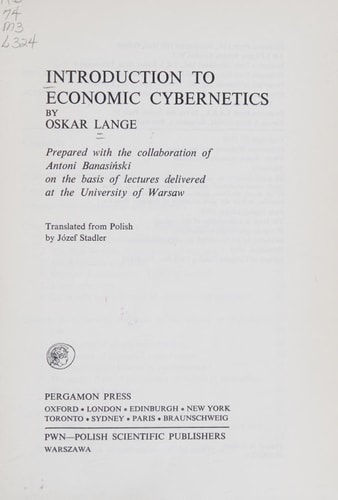
Introduction to Economic Cybernetics
0
0
As an Amazon Associate and affiliate partner, Menrva Books earns from qualifying purchases. Learn more
Author Description
Introduction to Economic Cybernetics introduces the reader to economic cybernetics, that is, the application of the principles of the theory of automatic control to the problems of managing the economic processes, and particularly the processes in a socialist economy. Topics covered include the general principles of regulation and control; cybernetic schemata of the theory of reproduction; the theory of stability of regulation systems; and a generalization of the theory of regulation. This book is comprised of five chapters and begins with an overview of economic cybernetics, followed by a discussion on the process of automatic regulation and how it functions, with particular reference to the basic formula of the theory of regulation and cybernetic interpretation of operations on operators. The following chapters focus on cybernetic schemata of the theory of reproduction; the dynamics of regulation processes; and the practical problems in regulation. The final chapter describes a general theory of regulation formalized as a linear differential-difference "equation of response", and gives the solution to this equation for both the homogeneous and non-homogeneous versions. This monograph will be a useful resource for practitioners of economics, physics, and mechanics.
Menrva's Summary
THE THESIS
This text investigates the application of automatic control theory principles to the management of economic processes, specifically within the context of a socialist economy. The author, Oskar Lange, utilizes his expertise in economic theory and mathematical modeling to propose a cybernetic framework for reproduction and regulation. The work formalizes economic management through the lens of linear differential-difference equations to solve for system stability and response.
THE SCOPE MAP
What You Will Find
- General principles of regulation and control systems
- Cybernetic schemata applied to the theory of reproduction
- Mathematical modeling of regulation dynamics
- Formalization of regulation via linear differential-difference equations
Scope Limits
- Focus is primarily restricted to the theoretical application within a socialist economic model
- Does not provide a comprehensive history of cybernetics outside of economic management
THE AUTHORITY PERSPECTIVE
Experts recognize this monograph as a specialized technical bridge between control engineering and mid-20th-century economic planning. Readers frequently note the high level of mathematical density required to follow the formalization of the regulation equations.
Page Count:
220
Publication Date:
1970-01-01
Publisher:
Pergamon Press Reprint
ISBN-10:
0080066526
ISBN-13:
9780080066523
Economics
Control Theory
Systems Theory
Cybernetics
Mathematics
Community Tags
Similar Books