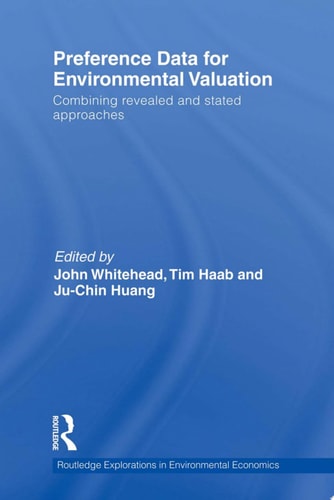
Preference Data for Environmental Valuation Combining Revealed and Stated Approaches
0
0
As an Amazon Associate and affiliate partner, Menrva Books earns from qualifying purchases. Learn more
Author Description
The monetary valuation of environmental goods and services has evolved from a fringe field of study in the late 1970s and early 1980s to a primary focus of environmental economists over the past decade. Despite its rapid growth, practitioners of valuation techniques often find themselves defending their practices to both users of the results of applied studies and, perhaps more troubling, to other practitioners. One of the more heated threads of this internal debate over valuation techniques revolves around the types of data to use in performing a valuation study. In the infant years of the development of valuation techniques, two schools of thought emerged: the revealed preference school and the stated preference school, the latter of which is perhaps most associated with the contingent valuation method. In the midst of this debate an exciting new approach to non-market valuation was developed in the 1990s: a combination and joint estimation of revealed preference and stated preference data. There are two primary objectives for this book. One objective is to fill a gap in the nonmarket valuation "primer" literature. A number of books have appeared over the past decade that develop the theory and methods of nonmarket valuation but each takes an individual nonmarket valuation method approach. This book considers each of these valuation methods in combination with another method. These relationships can be exploited econometrically to obtain more valid and reliable estimates of willingness-to-pay relative to the individual methods. The second objective is to showcase recent and novel applications of data combination and joint estimation via a set of original, state-of-the-art studies that are contributed by leading researchers in the field. This book will be accessible to economists and consultants working in business or government, as well as an invaluable resource for researchers and students alike.
Menrva's Summary
THE THESIS
This book investigates the integration of revealed and stated preference data to achieve more accurate monetary valuations of environmental goods and services. The authors address the ongoing debate within environmental economics regarding data sources for valuation studies, specifically the tension between revealed and stated preference schools. It aims to fill a gap in the literature by presenting a combined approach to non-market valuation, exploiting econometric relationships for more valid and reliable willingness-to-pay estimates. The work showcases novel applications through original studies by leading researchers, making it accessible to practitioners and students alike.
THE SCOPE MAP
- Theoretical frameworks for combining revealed and stated preference data in environmental valuation.
- Econometric techniques for joint estimation of valuation models.
- Case studies and applications of combined valuation methods.
- Analysis of the strengths and limitations of individual valuation approaches.
- Discussions on improving the validity and reliability of willingness-to-pay estimates.
- Contributions from leading researchers in the field of environmental economics.
THE AUTHORITY PERSPECTIVE
This book is positioned as a comprehensive resource for economists and consultants engaged in environmental valuation. Its focus on combining revealed and stated preference data addresses a key methodological debate within the field, offering advanced econometric approaches. The inclusion of original studies by leading researchers suggests a contribution to the state-of-the-art in non-market valuation techniques. The text is intended to serve both as a primer for those new to the combined approach and as an invaluable reference for established academics and students.
Page Count:
304
Publication Date:
2012-03-15
Publisher:
Routledge
ISBN-10:
1136812229
ISBN-13:
9781136812224
Science & Technology
Economics
Non-Fiction
Econometrics
Community Tags
Similar Books



Reader Comments
Share Your Thoughts
No comments yet. Be the first to share your thoughts!