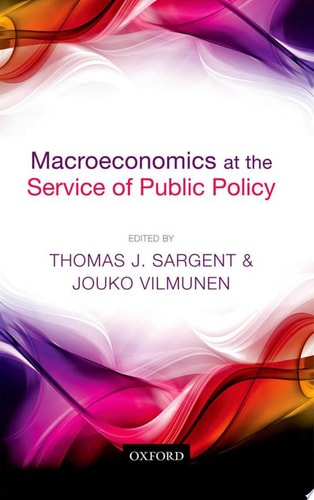
Macroeconomics at the Service of Public Policy
0
0
As an Amazon Associate and affiliate partner, Menrva Books earns from qualifying purchases. Learn more
Author Description
This volume uses state of the art models from the frontier of macroeconomics to answer key questions about how the economy functions and how policy should be conducted. The contributions cover a wide range of issues in macroeconomics and macroeconomic policy. They combine high level mathematics with economic analysis, and highlight the need to update our mathematical toolbox in order to understand the increased complexity of the macroeconomic environment. The volume represents hard evidence of high research intensity in many fields of macroeconomics, and warns against interpreting the scope of macroeconomics too narrowly. The mainstream business cycle analysis, based on dynamic stochastic general equilibrium (DSGE) modelling of a particular type, has been criticised for its inability to predict or resolve the recent financial crisis. However, macroeconomic research on financial, information, and learning imperfections had not yet made their way into many of the pre-crisis DSGE models because practical econometric versions of those models were mainly designed to fit data periods that did not include financial crises. A major response to the limitations of those older DSGE models is an active research program to bring big financial shocks and various kinds of financial, learning, and labour market frictions into a new generation of DSGE models for guiding policy. The contributors to this book utilise models and modelling assumptions that go beyond particular modelling conventions. By using alternative yet plausible assumptions, they seek to enrich our knowledge and ability to explain macroeconomic phenomena. They contribute to expanding the frontier of macroeconomic knowledge in ways that will prove useful for macroeconomic policy.
Menrva's Summary
THE THESIS
This volume investigates how modern macroeconomic models can be refined and applied to address the complexities of public policy in a post-financial crisis environment. The authors, Jouko Vilmunen and Nobel laureate Thomas J. Sargent, curate a collection of research that bridges the gap between theoretical economic analysis and practical policy implementation. By integrating advanced mathematical frameworks with empirical data, the text argues for an evolution in modeling techniques to better account for financial frictions, information imperfections, and market shocks.
THE SCOPE MAP
What You Will Find
- Advanced dynamic stochastic general equilibrium (DSGE) modeling techniques.
- Analysis of financial, information, and learning imperfections in economic systems.
- Methodologies for incorporating labor market frictions into macroeconomic policy frameworks.
- Critical evaluation of pre-crisis economic models and their limitations in predicting financial instability.
THE AUTHORITY PERSPECTIVE
Experts recognize this volume as a sophisticated contribution to the field of macroeconomic research, particularly for its focus on updating the mathematical tools used by policymakers. Readers frequently note the high level of technical density, making it a resource primarily intended for academic researchers and advanced students of economics.
Page Count:
192
Publication Date:
2013-05-05
Publisher:
Oxford University Press
ISBN-10:
0199666121
ISBN-13:
9780199666126
Economics
Finance
Econometrics
Macroeconomics
Public Policy
Community Tags
Other Editions(3)

Similar Books





Reader Comments
Share Your Thoughts
No comments yet. Be the first to share your thoughts!