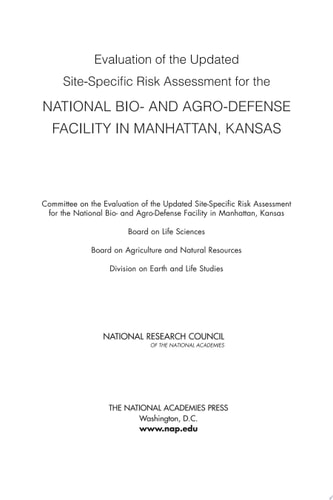
Evaluation of the Updated Site-Specific Risk Assessment for the National Bio- and Agro-Defense Facility in Manhattan, Kansas
0
0
As an Amazon Associate and affiliate partner, Menrva Books earns from qualifying purchases. Learn more
Author Description
Safeguarding U.S. agriculture from foreign animal diseases and protecting our food system require cutting-edge research and diagnostic capabilities. The Department of Homeland Security (DHS) and the U.S. Department of Agriculture (USDA) have embarked on an important mission to replace the aging Plum Island Animal Disease Center (PIADC) with a new facility, the National Bio- and Agro-Defense Facility (NBAF). When operational, this new facility would be the world's fourth biosafety level-4 laboratory capable of large animal research. It would serve as a critical world reference laboratory for identifying emerging and unknown disease threats, and would thus be a critical asset in securing the future health, wealth, and security of the nation. DHS selected Manhattan, Kansas, as the site for the new NBAF after an extensive site-selection process that involved an environmental impact statement. The Government Accountability Office (GAO) raised concerns about DHS's analysis of the potential spread of foot-and-mouth disease virus (FMDv), one of the most serious foreign animal disease threats. Congress directed DHS to conduct a site-specific risk assessment (SSRA) for the NBAF, instructed the National Research Council (NRC) to independently evaluate the SSRA, and prohibited obligation of NBAF construction funds until the NRC review was complete. Congress mandated that DHS revise its SSRA to address shortcomings of the 2010 SSRA, directed the NRC to evaluate the updated SSRA (uSSRA), and again prohibited obligation of construction funds until the completion of the second review. The scope for both of these SSRA reports addressed accidental release of pathogens from the NBAF in Manhattan, Kansas and excluded terrorist acts and malicious threats from its risk assessments. Evaluation of the Updated Site-Specific Risk Assessment for the National Bio- and Agro-Defense Facility in Manhattan, Kansas is the evaluation of the final uSSRA.
Menrva's Summary
THE THESIS
The National Bio- and Agro-Defense Facility (NBAF) in Manhattan, Kansas, faces scrutiny over its site-specific risk assessment (SSRA) concerning the potential accidental release of pathogens. The U.S. Department of Homeland Security and the U.S. Department of Agriculture are developing the NBAF to replace the Plum Island Animal Disease Center, aiming to enhance research and diagnostic capabilities for foreign animal diseases. This facility, designed as a biosafety level-4 laboratory for large animal research, is intended to be a critical reference laboratory for emerging disease threats. Following concerns raised by the Government Accountability Office regarding the analysis of foot-and-mouth disease virus spread, Congress mandated an updated SSRA and an independent evaluation by the National Research Council. This report specifically evaluates the final updated SSRA, which focused on accidental releases and excluded malicious threats.
THE SCOPE MAP
- Evaluation of the updated Site-Specific Risk Assessment (uSSRA) for the National Bio
- and Agro-Defense Facility (NBAF).
- Analysis of potential accidental release of pathogens, specifically foot-and-mouth disease virus (FMDv), from the NBAF.
- Review of the methodology and findings of the DHS's risk assessment process.
- Consideration of the facility's role as a biosafety level-4 laboratory for large animal research.
- Assessment of the NBAF's importance in safeguarding U.S. agriculture and the food system against foreign animal diseases.
- Contextual information on the replacement of the Plum Island Animal Disease Center (PIADC).
THE AUTHORITY PERSPECTIVE
This report serves as an independent evaluation of the updated site-specific risk assessment for the National Bio- and Agro-Defense Facility. The assessment focuses on the potential for accidental pathogen release, a critical concern highlighted by previous governmental reviews. The National Research Council's review was mandated by Congress to ensure the adequacy of the risk analysis before construction funds could be obligated. The findings and recommendations within this evaluation are intended to inform decisions regarding the facility's safety and operational readiness.
Page Count:
132
Publication Date:
2012-09-24
Publisher:
National Academies Press
ISBN-10:
0309257824
ISBN-13:
9780309257824
Science & Technology
Non-Fiction
Science
Government
Public Health
Community Tags
Similar Books













Reader Comments
Share Your Thoughts
No comments yet. Be the first to share your thoughts!