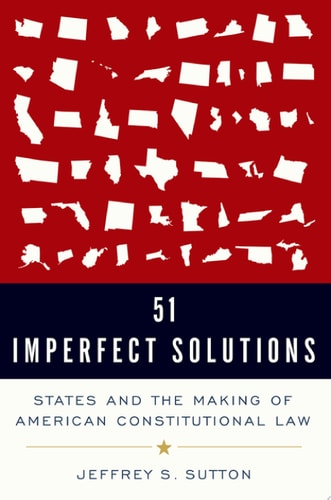
51 Imperfect Solutions: States and the Making of American Constitutional Law
0
0
As an Amazon Associate and affiliate partner, Menrva Books earns from qualifying purchases. Learn more
Author Description
When we think of constitutional law, we invariably think of the United States Supreme Court and the federal court system. Yet much of our constitutional law is not made at the federal level. In 51 Imperfect Solutions, U.S. Court of Appeals Judge Jeffrey S. Sutton argues that American Constitutional Law should account for the role of the state courts and state constitutions, together with the federal courts and the federal constitution, in protecting individual liberties. The book tells four stories that arise in four different areas of constitutional law: equal protection; criminal procedure; privacy; and free speech and free exercise of religion. Traditional accounts of these bedrock debates about the relationship of the individual to the state focus on decisions of the United States Supreme Court. But these explanations tell just part of the story. The book corrects this omission by looking at each issue-and some others as well-through the lens of many constitutions, not one constitution; of many courts, not one court; and of all American judges, not federal or state judges. Taken together, the stories reveal a remarkably complex, nuanced, ever-changing federalist system, one that ought to make lawyers and litigants pause before reflexively assuming that the United States Supreme Court alone has all of the answers to the most vexing constitutional questions. If there is a central conviction of the book, it's that an underappreciation of state constitutional law has hurt state and federal law and has undermined the appropriate balance between state and federal courts in protecting individual liberty. In trying to correct this imbalance, the book also offers several ideas for reform.
Menrva's Summary
THE THESIS
The central question investigated is why American constitutional law has become overly reliant on the United States Supreme Court while neglecting the vital role of state constitutions and state courts in protecting individual liberties. Judge Jeffrey S. Sutton, a sitting U.S. Court of Appeals judge, utilizes his extensive judicial experience to challenge the federal-centric narrative of American law. He argues that the current imbalance undermines the federalist system and limits the potential for diverse legal protections. By examining historical and contemporary case law, Sutton proposes a recalibration that restores state courts to their intended position as primary guardians of rights.
THE SCOPE MAP
What You Will Find
- Analysis of four specific legal domains: equal protection, criminal procedure, privacy, and free speech/religion.
- A historical framework of the development of state versus federal constitutional jurisprudence.
- Proposed reforms for legal practitioners and litigants to better utilize state-level constitutional arguments.
Scope Limits
- The book does not provide an exhaustive survey of all fifty states, focusing instead on illustrative case studies.
- It does not offer a comprehensive history of the entire American legal system, concentrating specifically on the interplay between state and federal constitutional authority.
THE AUTHORITY PERSPECTIVE
Legal scholars and practitioners frequently cite this work as a significant contribution to the study of federalism and judicial interpretation. Experts highlight the text as a necessary corrective to the federal-centric bias prevalent in modern legal education and practice.
Page Count:
292
Publication Date:
2018-01-01
Publisher:
Oxford University Press
ISBN-10:
0190866063
ISBN-13:
9780190866068
American History
Government
Federalism
Constitutions
Constitutional Law
Law
Professional Career & Trade
Judicial System
Community Tags
Similar Books