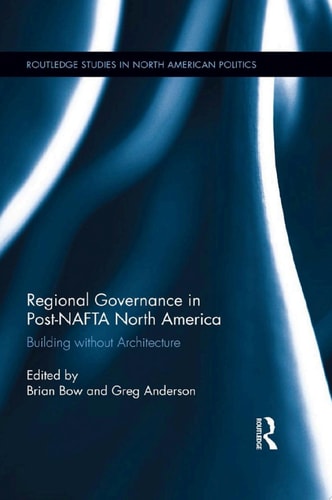
Regional Governance in Post-NAFTA North America
0
0
As an Amazon Associate and affiliate partner, Menrva Books earns from qualifying purchases. Learn more
Author Description
Twenty years after NAFTA, the consensus seems to be that the regional project in North America is dead. The trade agreement was never followed up by new institutions that might cement a more ambitious regional community. The Security and Prosperity Partnership (SPP), launched with some fanfare in 2005, was quietly discontinued in 2009. And new cooperative ventures like the US‐Canada Beyond the Border talks and the US‐Mexico Merida Initiative suggest that the three governments have reverted to the familiar, pre‐NAFTA pattern of informal, incremental bilateralism. One could argue, however, that NAFTA itself has been buried, and yet the region somehow lives on, albeit in a form very different from regional integration in other parts of the world. A diverse group of contributors, from the United States, Canada, and Mexico, with experience in academia, government service, think tanks and the private sector bring to bear a sophisticated and much needed examination of regional governance in North America, its historical origins, its connection to the regional distribution of power and the respective governments’ domestic institutions, and the variance of its forms and function across different issue areas. The editors begin by surveying the literature on North American regional politics, matching up developments there with parallel debates and controversies in the broader literatures on comparative regional integration and international policy coordination more generally. Six contributors later explore the mechanisms of policy coordination in specific issue-areas, each with an emphasis on a particular set of actors, and with its own way of characterizing the relevant political and diplomatic dynamics. Chapters on the political context for regional policy coordination follow leading to concluding remarks on the future of North America. At a time when scholarly interest in North America seems to be waning, even while important and interesting political and economic developme
Menrva's Summary
THE THESIS
This book examines the state of regional governance in North America two decades after the implementation of NAFTA, questioning the prevailing notion that the regional project has failed. It argues that despite the absence of new institutional frameworks and the discontinuation of initiatives like the Security and Prosperity Partnership (SPP), North America continues to exist as a region, albeit in a form distinct from other global integration models. The work features contributions from academics, government officials, and private sector experts from the United States, Canada, and Mexico, offering a sophisticated analysis of the historical origins of North American regional politics, its relationship to power distribution and domestic institutions, and its varied forms across different issue areas.
THE SCOPE MAP
- Analysis of the literature on North American regional politics and its parallels with comparative regional integration debates.
- Exploration of policy coordination mechanisms in specific issue-areas, focusing on particular actors and diplomatic dynamics.
- Examination of the political context surrounding regional policy coordination.
- Discussion of the historical origins of regional governance in North America.
- Assessment of the relationship between regional governance, power distribution, and domestic institutions.
- Analysis of the variance in regional governance forms and functions across different issue areas.
- Concluding remarks on the future trajectory of North America.
THE AUTHORITY PERSPECTIVE
The book offers a nuanced perspective on North American regional governance, challenging the common view that the post-NAFTA era signifies the end of regional integration. Contributors explore the complex interplay of historical factors, power dynamics, and domestic institutions that shape regional cooperation. The collection is structured to provide both a broad overview of the literature and in-depth case studies of policy coordination across various issue areas. It aims to stimulate further scholarly interest in North America at a time when such engagement may seem to be declining.
Page Count:
272
Publication Date:
2014-10-30
Publisher:
Taylor & Francis
ISBN-10:
1317680081
ISBN-13:
9781317680086
Non-Fiction
Politics
Economics
International relations
North America
Community Tags
Similar Books