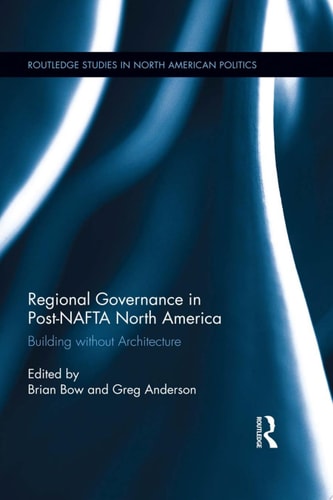
Regional Governance in Post-NAFTA North America: Building without Architecture
0
0
As an Amazon Associate and affiliate partner, Menrva Books earns from qualifying purchases. Learn more
Author Description
Twenty years after NAFTA, the consensus seems to be that the regional project in North America is dead. The trade agreement was never followed up by new institutions that might cement a more ambitious regional community. The Security and Prosperity Partnership (SPP), launched with some fanfare in 2005, was quietly discontinued in 2009. And new cooperative ventures like the US‐Canada Beyond the Border talks and the US‐Mexico Merida Initiative suggest that the three governments have reverted to the familiar, pre‐NAFTA pattern of informal, incremental bilateralism. One could argue, however, that NAFTA itself has been buried, and yet the region somehow lives on, albeit in a form very different from regional integration in other parts of the world. A diverse group of contributors, from the United States, Canada, and Mexico, with experience in academia, government service, think tanks and the private sector bring to bear a sophisticated and much needed examination of regional governance in North America, its historical origins, its connection to the regional distribution of power and the respective governments’ domestic institutions, and the variance of its forms and function across different issue areas. The editors begin by surveying the literature on North American regional politics, matching up developments there with parallel debates and controversies in the broader literatures on comparative regional integration and international policy coordination more generally. Six contributors later explore the mechanisms of policy coordination in specific issue-areas, each with an emphasis on a particular set of actors, and with its own way of characterizing the relevant political and diplomatic dynamics. Chapters on the political context for regional policy coordination follow leading to concluding remarks on the future of North America. At a time when scholarly interest in North America seems to be waning, even while important and interesting political and eco
Menrva's Summary
THE THESIS
The book investigates the state of regional governance in North America two decades after the implementation of NAFTA, questioning whether the regional project is truly defunct or merely transformed. It examines the historical origins of North American regional politics, its relationship to the distribution of power and domestic institutions, and its varied forms across different issue areas, drawing on a diverse group of contributors with expertise in academia, government, think tanks, and the private sector. The work begins with a survey of existing literature on North American regional politics, situating developments within broader debates on comparative regional integration and international policy coordination. Subsequent chapters explore specific mechanisms of policy coordination, focusing on particular actors and diplomatic dynamics, before concluding with remarks on the future of the region.
THE SCOPE MAP
- Analysis of the historical origins of North American regional governance.
- Examination of the connection between regional power distribution and domestic institutions.
- Exploration of the variance in regional governance forms and functions across different issue areas.
- Survey of literature on North American regional politics and comparative regional integration.
- Case studies on mechanisms of policy coordination in specific issue-areas.
- Discussion of the political context for regional policy coordination.
- Concluding remarks on the future of North America.
THE AUTHORITY PERSPECTIVE
The book offers a sophisticated examination of North American regional governance, presenting arguments that challenge the notion of its demise post-NAFTA. Contributors from diverse backgrounds provide nuanced perspectives on the historical evolution and current state of regional cooperation. The work is structured to first survey the existing literature and then delve into specific issue areas, offering a comprehensive overview for scholars and policymakers. The analysis suggests that while formal institutions may be lacking, informal and incremental bilateralism continues to shape the region's dynamics.
Page Count:
272
Publication Date:
2014-10-30
Publisher:
Routledge
ISBN-10:
131768009X
ISBN-13:
9781317680093
Non-Fiction
Politics
Economics
International relations
Community Tags
Similar Books













Reader Comments
Share Your Thoughts
No comments yet. Be the first to share your thoughts!