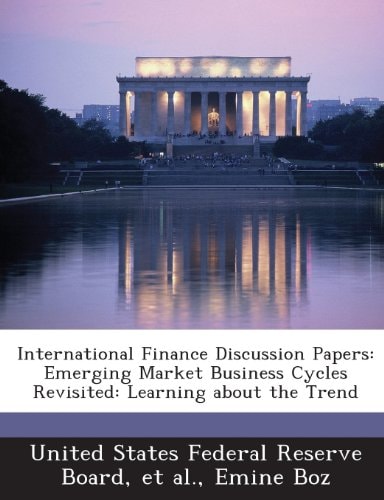
International Finance Discussion Papers: Emerging Market Business Cycles Revisited: Learning about the Trend
0
0
As an Amazon Associate and affiliate partner, Menrva Books earns from qualifying purchases. Learn more
Author Description
The data reveal that emerging markets do not differ from developed countries with regards to the variance of permanent TFP shocks relative to transitory. They do differ, however, in the degree of uncertainty agents face when formulating expectations. Based on these observations, we build an equilibrium business cycle model in which the agents cannot perfectly distinguish between the permanent and transitory components of TFP shocks. When formulating expectations, they assign some probability to TFP shocks being permanent even when they are purely transitory. This is sufficient for the model to produce "permanent-like" effects in response to transitory shocks. The imperfect information model calibrated to Mexico predicts a higher variability of consumption relative to output and a strongly negative correlation between the trade balance and output, without the predominance of trend shocks. The same model assuming perfect information and calibrated to Canada accounts for developed country business cycle regularities. The estimated relative variance of trend shocks in these two models is similar.
Menrva's Summary
THE THESIS
This paper investigates the cyclical behavior of emerging market economies by examining the role of information uncertainty in business cycle models. The research, authored by Emine Boz, analyzes data to compare emerging and developed markets, finding that while the variance of permanent TFP shocks is similar, emerging markets exhibit greater uncertainty in agents' expectations. Boz constructs an equilibrium business cycle model where agents struggle to differentiate between permanent and transitory TFP shocks, assigning a probability to transitory shocks being permanent. This imperfect information framework is calibrated to Mexico and predicts business cycle patterns that align with observed data, such as higher consumption variability relative to output and a negative correlation between trade balance and output, without relying on trend shocks.
THE SCOPE MAP
- Analysis of permanent TFP shocks relative to transitory shocks in emerging vs. developed markets.
- Development of an equilibrium business cycle model with imperfect information.
- Modeling agents' difficulty in distinguishing permanent from transitory TFP shocks.
- Calibration of the model to Mexico to predict consumption and output variability.
- Examination of the correlation between trade balance and output in emerging markets.
- Comparison of model predictions with perfect information calibration for developed countries (Canada).
- Estimation of the relative variance of trend shocks in both imperfect and perfect information models.
THE AUTHORITY PERSPECTIVE
The research presented in this paper offers a nuanced perspective on emerging market business cycles, moving beyond simple trend shock explanations. By incorporating imperfect information and agent expectations, the model provides a framework for understanding observed economic regularities in countries like Mexico. The comparison with developed economies, such as Canada, highlights the distinct challenges and characteristics of emerging markets. This work contributes to the literature by demonstrating how uncertainty in shock identification can generate significant 'permanent-like' effects from transitory disturbances.
Page Count:
42
Publication Date:
2013-02-08
Publisher:
BiblioGov
ISBN-10:
1288727259
ISBN-13:
9781288727254
Economics
Non-Fiction
Finance
Community Tags
Similar Books