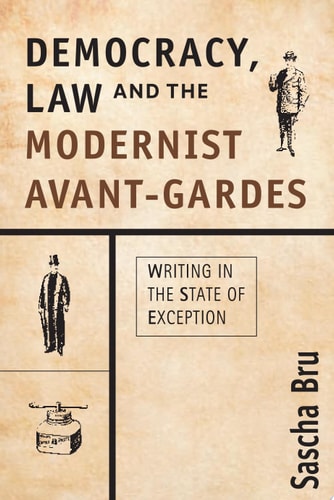
Democracy, Law and the Modernist Avant-Gardes Writing in the State of Exception
0
0
As an Amazon Associate and affiliate partner, Menrva Books earns from qualifying purchases. Learn more
Author Description
This is the first book to look at the ties between European modernism and democracy in a cross-cultural manner. Focusing on the continental avant-gardes of the nineteen-tens and twenties, Sascha Bru's original and provocative book fundamentally revises our understanding of modernism's cultural and political history. Bru brings together a wide range of European experimental writers and provides detailed analyses of Italian futurist F.T. Marinetti, German Dadaist Richard Huelsenbeck and Belgian expressionist Paul van Ostaijen. Bru locates these writers within their exceptional democratic context and demonstrates how the modernist avant-garde, during the First World War and the upheavals that followed, found itself caught up in a series of 'states of exception'. In such states legal democratic institutions were bracketed and set aside, and 'literature' as an autonomous realm was temporarily suspended. Faced with extreme forms of politicisation, avant-gardists throughout Europe tried to safeguard literature's autonomy in a variety of ways. These included turning politics and law into genuinely artistic materials and producing a repertoire of alternatives to existent frameworks of democracy.Against assertions that anti-art avant-garde gestures were meant to overcome art's autonomy and approximate the condition of politics, Bru shows that European avant-gardists may well have been one of the staunchest defenders of art's sovereignty in modern times.Key Features* Facilitates dialogue between Anglo-American and European modernist studies* Presents new interpretations of Berlin Dada, futurism and expressionism, and brings an innovative historical framework with which to analyse continental modernism* Provides an original perspective on modernist writing and theory during the first decades of the foregoing century* Offers, in the introductory chapter, a survey of ways in which to relate experimental writing to politics
Menrva's Summary
THE THESIS
This book investigates the complex relationship between European modernist avant-gardes and the concept of democracy, particularly within the context of the 'state of exception'. Sascha Bru, drawing on extensive cross-cultural analysis, argues that modernist writers, far from seeking to abolish art's autonomy, were in fact staunch defenders of its sovereignty during periods of political upheaval. The study examines how writers like F.T. Marinetti, Richard Huelsenbeck, and Paul van Ostaijen navigated extreme politicization by incorporating law and politics into their artistic materials and proposing alternatives to existing democratic frameworks.
THE SCOPE MAP
- Cross-cultural examination of European modernism and democracy.
- Detailed analyses of Italian Futurism (F.T. Marinetti), German Dadaism (Richard Huelsenbeck), and Belgian Expressionism (Paul van Ostaijen).
- Exploration of the 'state of exception' during WWI and its aftermath.
- Analysis of how avant-garde writers responded to extreme politicization and sought to safeguard literature's autonomy.
- New interpretations of Berlin Dada, Futurism, and Expressionism.
- An innovative historical framework for analyzing continental modernism.
- A survey of approaches to relating experimental writing to politics.
THE AUTHORITY PERSPECTIVE
The book is recognized for its original and provocative approach to understanding modernism's cultural and political history. It facilitates dialogue between Anglo-American and European modernist studies by presenting new interpretations of key avant-garde movements and offering an innovative analytical framework. The work provides a fresh perspective on modernist writing and theory from the early 20th century, particularly highlighting the role of the 'state of exception' in shaping artistic responses. By demonstrating how avant-gardists defended art's sovereignty, the book challenges previous assertions about anti-art gestures.
Page Count:
264
Publication Date:
2009-10-20
Publisher:
Edinburgh University Press
ISBN-10:
0748641769
ISBN-13:
9780748641765
History
Politics
Non-Fiction
Literary Criticism
European History
Modernism
Community Tags
Similar Books