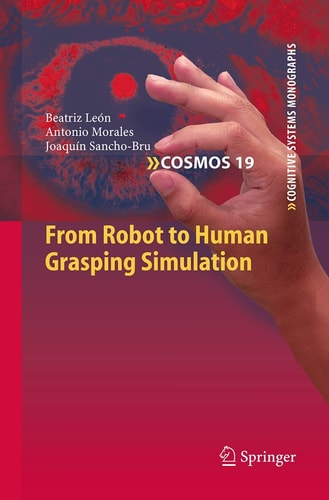
From Robot to Human Grasping Simulation
0
0
As an Amazon Associate and affiliate partner, Menrva Books earns from qualifying purchases. Learn more
Author Description
The human hand and its dexterity in grasping and manipulating objects are some of the hallmarks of the human species. For years, anatomic and biomechanical studies have deepened the understanding of the human hand’s functioning and, in parallel, the robotics community has been working on the design of robotic hands capable of manipulating objects with a performance similar to that of the human hand. However, although many researchers have partially studied various aspects, to date there has been no comprehensive characterization of the human hand’s function for grasping and manipulation of everyday life objects. This monograph explores the hypothesis that the confluence of both scientific fields, the biomechanical study of the human hand and the analysis of robotic manipulation of objects, would greatly benefit and advance both disciplines through simulation. Therefore, in this book, the current knowledge of robotics and biomechanics guides the design and implementation of a simulation framework focused on manipulation interactions that allows the study of the grasp through simulation. As a result, a valuable framework for the study of the grasp, with relevant applications in several fields such as robotics, biomechanics, ergonomics, rehabilitation and medicine, has been made available to these communities.
Menrva's Summary
THE THESIS
This monograph investigates the hypothesis that integrating biomechanical studies of the human hand with robotic manipulation analysis through simulation can significantly advance both fields. The authors, drawing on years of research in anatomy, biomechanics, and robotics, propose a simulation framework to study grasping and manipulation of everyday objects. Their work aims to bridge the gap between understanding human dexterity and designing robotic hands with comparable performance, addressing the lack of comprehensive characterization in this area to date.
THE SCOPE MAP
- A comprehensive characterization of the human hand's function for grasping and manipulation.
- Exploration of the hypothesis that combining biomechanics and robotics through simulation benefits both disciplines.
- Design and implementation of a simulation framework focused on manipulation interactions.
- Study of the grasp through simulation, guided by current knowledge in robotics and biomechanics.
- Applications in robotics, biomechanics, ergonomics, rehabilitation, and medicine.
THE AUTHORITY PERSPECTIVE
This work is presented as a monograph that offers a valuable framework for the study of grasping, intended for communities in robotics, biomechanics, ergonomics, rehabilitation, and medicine. The authors' approach integrates existing knowledge from both human hand biomechanics and robotic manipulation to create a simulation-based study. The book's utility is highlighted by its potential applications across these diverse scientific and medical fields.
Page Count:
261
Publication Date:
2016-08-23
Publisher:
Springer International Publishing
ISBN-10:
3319349317
ISBN-13:
9783319349312
Science
Non-Fiction
Ergonomics
Rehabilitation
Biomechanics
Medicine
Robotics
Simulation
Community Tags
Similar Books