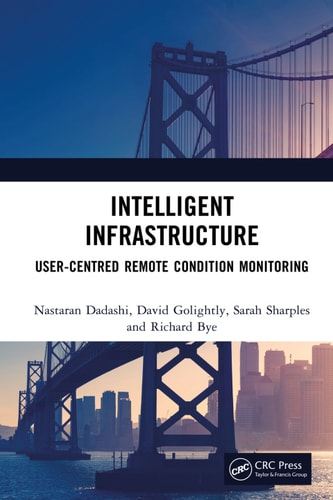
Intelligent Infrastructure
0
0
As an Amazon Associate and affiliate partner, Menrva Books earns from qualifying purchases. Learn more
Author Description
With the development of sensor technology, wireless communications, big data, and machine learning, there is an increasing interest in technologies and solutions that assess and predict the state of equipment and assets within various industrial settings. These technologies aim to collect information from multiple sources about infrastructure asset status. Then, through current and historical data analysis, this configuration of technologies delivers intelligence on current and future asset status to a maintenance operator or manager to inform optimal maintenance decision-making. These technologies are known under different terms – remote condition monitoring, e-maintenance, prognostic systems, predictive maintenance, and smart or intelligent infrastructure. Despite the promise of remote condition monitoring and predictive technologies, there is a growing concern with such technologies because they can be difficult or impractical to use. Understanding and mitigating potential human factors issues could ensure that such vast investments are not wasted. This book considers, in depth, the challenges placed on users of current and future condition monitoring systems. Its primary focus is to understand the cognitive processes, including managing alarms, interpreting data, and collaborating with automation. The book describes a range of human factors methods that can be used to understand the current and future functioning of people and technology in an enhanced maintenance and asset monitoring context. The book also presents a framework for describing these issues systematically and presents the resulting design considerations to increase the effectiveness of individual operators and organisations as a whole.
Menrva's Summary
THE THESIS
This book investigates the integration of advanced technologies into industrial infrastructure for predictive maintenance and asset management. It addresses the growing interest in sensor technology, wireless communications, big data, and machine learning to assess and predict equipment status. The authors explore the challenges and human factors issues associated with these systems, focusing on cognitive processes like alarm management, data interpretation, and collaboration with automation. The book aims to provide a framework and design considerations to enhance the effectiveness of operators and organizations utilizing these intelligent systems.
THE SCOPE MAP
- Technologies for remote condition monitoring, e-maintenance, prognostic systems, and predictive maintenance.
- Analysis of human factors issues in condition monitoring systems.
- Examination of cognitive processes including alarm management, data interpretation, and human-automation collaboration.
- Description of human factors methods for understanding people and technology in maintenance and asset monitoring.
- A framework for systematically describing human factors issues in intelligent infrastructure.
- Design considerations to improve the effectiveness of individual operators and organizations.
THE AUTHORITY PERSPECTIVE
The book addresses a critical intersection of technology and human factors in industrial asset management. Its focus on cognitive processes and practical design considerations suggests it is aimed at professionals and researchers in engineering, operations management, and human-computer interaction. The comprehensive approach, covering both technological advancements and user-centric challenges, positions it as a valuable resource for understanding and optimizing the implementation of intelligent infrastructure.
Page Count:
336
Publication Date:
2023-07-30
Publisher:
Taylor & Francis
ISBN-10:
1317120485
ISBN-13:
9781317120483
Non-Fiction
Science & Technology
Infrastructure
Human Factors
Automation
Machine Learning
Big data
Community Tags
Similar Books