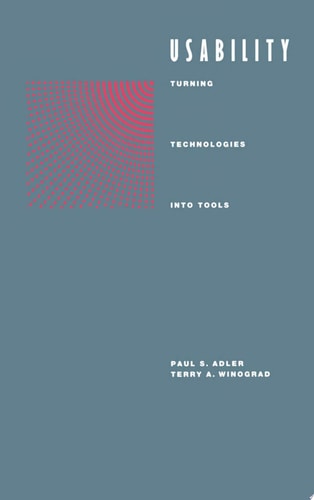
Usability: Turning Technologies into Tools
0
0
As an Amazon Associate and affiliate partner, Menrva Books earns from qualifying purchases. Learn more
Author Description
As more and more equipment incorporates advanced technologies, usability -- the ability of equipment to take advantage of users' skills and thereby to function effectively in the broad range of real work situations -- is becoming an essential component of equipment design. Usability: Turning Technologies into Tools collects six essays that herald a fundamental shift in the way industry and researchers think about usability. In this new, broader definition, usability no longer means safeguarding against human error, but rather enabling human beings to learn, to use, and to adapt the equipment to satisfy better the demands and contingencies of their work. Following an introduction that develops some core concepts of usability, the subsequent chapters: -- describe the role of usability in guiding one of Xerox's largest strategic initiatives -- analyze a Monsanto chemical plant where a study of worker's conversational patterns contributed to the design of a more effective system of controls -- present an empirical study of equipment design practices in U.S. industry which contrasts technology-centered and skill-based design approaches -- summarize recent Scandinavian experiences with user participation in design, with specific reference to the DEMOS and UTOPIA projects -- analyze European experiences that suggest five key criteria for effective human-centered design of advanced manufacturing technology --offer an insightful discussion of the powerful, often hidden human and organizational resources that conventional design processes overlook. Today, three quarters of all advanced technology implementations in manufacturing fail to achieve their performance goals because of inadequate usability. By viewing the human being as a mechanistic system component, and not a particularly reliable one, the traditional "human factors" model of usability virtually ensures that the uniquely human qualities -- experience, adaptation, innovation -- will be neglected, and therefore that
Menrva's Summary
THE THESIS
This book investigates the critical failure of advanced technology implementations in manufacturing and argues for a shift from traditional human-factors models to a skill-based design approach. Authors Paul S. Adler and Terry A. Winograd, drawing on industrial case studies and organizational research, contend that usability must be redefined as the capacity of equipment to leverage human expertise, adaptation, and innovation rather than merely minimizing human error.
THE SCOPE MAP
What You Will Find
- Analysis of strategic design initiatives at major corporations like Xerox and Monsanto.
- Comparative studies between technology-centered and skill-based design methodologies.
- Examination of Scandinavian user-participation frameworks, including the DEMOS and UTOPIA projects.
- Five established criteria for the human-centered design of advanced manufacturing systems.
THE AUTHORITY PERSPECTIVE
Experts recognize this text as a foundational critique of conventional industrial design practices that treat human operators as unreliable system components. Readers frequently note the practical utility of the case studies in bridging the gap between theoretical human-computer interaction and real-world manufacturing performance.
Page Count:
224
Publication Date:
1992-09-24
Publisher:
Oxford University Press
ISBN-10:
0195075102
ISBN-13:
9780195075106
Business
Technology
Automation
Engineering
Manufacturing
Human Factors
Design
Computer Interfaces
System Design
Community Tags
Similar Books