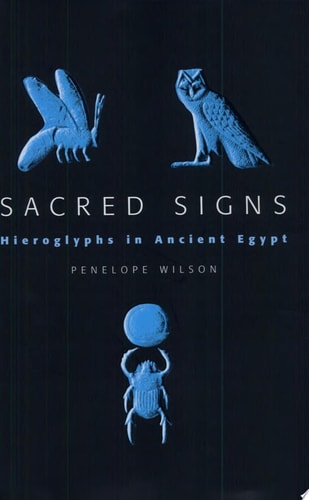
Sacred Signs: Hieroglyphs in Ancient Egypt
0
0
As an Amazon Associate and affiliate partner, Menrva Books earns from qualifying purchases. Learn more
Author Description
The hieroglyphs of ancient Egypt have fascinated people for over three thousand years. In this engaging new study, Penelope Wilson offers a wide ranging look at this ancient form of writing, touching on everything from basic principles of translation to its broader function in Egyptian culture.Sacred Signs illuminates the cultural significance of hieroglyphs, showing how it was used in monumental art and as the rarified language of the gods. Wilson points out that the Egyptian word for pictorial writing was "medu-netjer," which means "words of god." Hieroglyphs were an exalted mode of communication, used to speak with the gods or to guide rulers in the afterlife (for instance, hieroglyphs might describe a set of spells, rituals, and the route to the afterlife for use by the king or queen). Indeed, hieroglyphs differed from everyday writing and the average Egyptian was unable to read them--only the elite were taught the pictorial signs. Throughout the book, Wilson illuminates the writing system itself. We learn that hieroglyphs can be read either left-to-right or right-to-left and that animals, birds, people, serpents, and fish were drawn in profile, all facing the same way, so that readers would know which way to read the line. Also, individual signs derived from everyday objects in the Egyptian world, so that learning hieroglyphs is not only a linguistic exercise, but also an insightful introduction to Egyptian culture and daily life.Written by an authority on hieroglyphics, Sacred Signs is the only book available that presents up-to-date evidence in an accessible way, illuminating the function and importance of hieroglyphs within the framework of ancient Egyptian culture.
Menrva's Summary
THE THESIS
This book investigates the linguistic structure, cultural function, and historical significance of Egyptian hieroglyphs within the context of ancient society. Penelope Wilson, an expert in the field, utilizes archaeological evidence and linguistic analysis to explain how this writing system served as a bridge between the mortal realm and the divine. The text argues that hieroglyphs were not merely a communication tool but a specialized, elite medium essential for religious rituals, royal guidance, and the preservation of cultural identity.
THE SCOPE MAP
What You Will Find
- Principles of translation and reading directionality
- The cultural role of hieroglyphs in monumental art and religious practice
- Analysis of the relationship between pictorial signs and everyday Egyptian objects
Scope Limits
- Does not serve as a comprehensive dictionary or exhaustive grammar textbook
- Focuses primarily on the cultural and symbolic function rather than a deep technical linguistic breakdown
THE AUTHORITY PERSPECTIVE
Experts and readers recognize this work as an accessible entry point for those interested in the intersection of language and ancient culture. The prose is noted for its clarity, making complex historical and linguistic concepts understandable for a general audience.
Page Count:
144
Publication Date:
2003-09-18
Publisher:
Oxford University Press
ISBN-10:
0192802992
ISBN-13:
9780192802996
Non-Fiction
History
Ancient Egypt
Linguistics
Archaeology
Egyptian language writing hieroglyphic
Community Tags
Similar Books