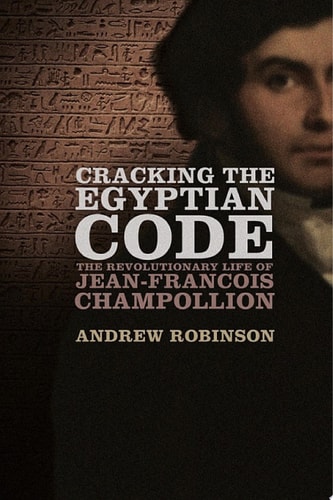
Cracking the Egyptian Code: The Revolutionary Life of Jean-Francois Champollion
0
0
As an Amazon Associate and affiliate partner, Menrva Books earns from qualifying purchases. Learn more
Author Description
In 1799 Napoleon's army uncovered an ancient stele in the Nile delta. Its inscription, recorded in three distinct scripts--ancient Greek, Coptic, and hieroglyphic--would provide scholars with the first clues to unlocking the secrets of Egyptian hieroglyphs, a language lost for nearly two millennia. More than twenty years later a remarkably gifted Frenchman named Jean-Francois Champollion successfully deciphered the hieroglyphs on the stele, now commonly known as the Rosetta Stone, sparking a revolution in our knowledge of ancient Egypt. Cracking the Egyptian Code is the first biography in English of Champollion, widely regarded as the founder of Egyptology. Andrew Robinson meticulously reconstructs how Champollion cracked the code of the hieroglyphic script, describing how Champollion started with Egyptian obelisks in Rome and papyri in European collections, sailed the Nile for a year, studied the tombs in the Valley of the Kings (a name he first coined), and carefully compared the three scripts on the Rosetta Stone to penetrate the mystery of the hieroglyphic text. Robinson also brings to life the rivalry between Champollion and the English scientist Thomas Young, who claimed credit for launching the decipherment, which Champollion hotly denied. There is much more to Champollion's life than the Rosetta Stone and Robinson gives equal weight to the many roles he played in his tragically brief life, from a teenage professor in Revolutionary France to a supporter of Napoleon (whom he met), an exile, and a curator at the Louvre. Extensively illustrated in color and black-and-white pictures, Cracking the Egyptian Code will appeal to a wide readership interested in Egypt, decipherment and code-breaking, and Napoleon and the French Revolution.
Menrva's Summary
THE THESIS
This biography investigates the intellectual process and personal history of Jean-Francois Champollion, the scholar who successfully deciphered the Rosetta Stone and established the field of Egyptology. Andrew Robinson, a seasoned writer on scientific and historical subjects, utilizes primary source documents, correspondence, and historical records to reconstruct the life of a man who unlocked a language lost for two millennia. The book argues that Champollion's success was the result of a lifelong obsession with linguistics and a rigorous, comparative methodology that transcended the efforts of his contemporaries. By situating Champollion within the volatile political landscape of Revolutionary and Napoleonic France, Robinson provides a comprehensive portrait of a polymath whose work transformed the study of the ancient world.
THE SCOPE MAP
What You Will Find
- A detailed account of the decipherment process involving the Rosetta Stone, Egyptian obelisks, and papyri collections.
- An analysis of the professional rivalry between Champollion and English scientist Thomas Young.
- A biographical overview of Champollion’s life, including his tenure as a teenage professor and his role as a curator at the Louvre.
- Historical context regarding the impact of the French Revolution and the Napoleonic era on European intellectual life.
THE AUTHORITY PERSPECTIVE
Experts and historians frequently praise this work for its accessible yet rigorous approach to a complex linguistic and historical subject. Readers often note that the text balances technical details of decipherment with a compelling narrative of Champollion's personal and political life, making it a foundational resource for those interested in the history of Egyptology.
Page Count:
272
Publication Date:
2012-01-01
Publisher:
Oxford University Press
ISBN-10:
0199942900
ISBN-13:
9780199942909
Biography
History
European History
English
Egyptology
English & College Success
Archaeology
Ancient History
Biography Autobiography
Egyptian language writing hieroglyphic
Egyptologists
Linguistics
Community Tags
Similar Books