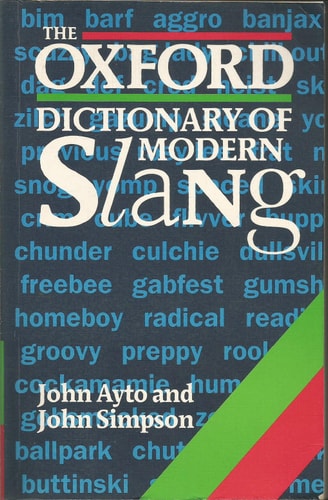
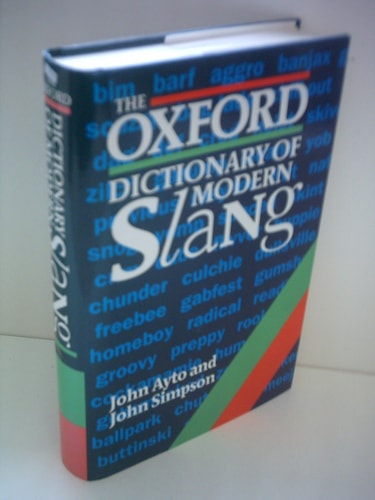
The Oxford Dictionary of Modern Slang
0
0
As an Amazon Associate and affiliate partner, Menrva Books earns from qualifying purchases. Learn more
Author Description
Slang is language with its sleeves rolled up, colorful, pointed, brash, bristling with humor and sometimes with hostility. From "forty-rod whiskey" and "five-finger discount" to "bum rap," "buzz off," and "fly by night," slang words add zest to everyday speech. Now, in The Oxford Dictionary of Modern Slang, John Simpson and John Ayto have gathered together a vibrant collection of over 5,000 slang terms, drawn from the vast Oxford English Dictionary database.Each entry contains the headword, part of speech, and definition. The great majority also have at least one illustrative example of the term in context, often drawn from writers such as John Updike, Gore Vidal, Louise Erdrich, Jessica Mitford, and Thomas Pynchon. Many entries contain labels indicating the social group or discipline from which a word derives--such as Black English, theatrical, military, or nautical--as well as the region where it originated. In addition, when the term has had more than one meaning, the various senses are listed chronologically. The changes in meaning are often fascinating: "Slush fund," originally a navy expression, referred to money collected from the sale of "slush" (fat or grease obtained from boiling meat) and used to buy luxuries for the crew. "Snow bird" originally meant someone who joined or rejoined the Army in the winter for food and shelter. And both "to give someone the bird" and "to goose someone" were theatrical terms meaning "to boo a bad performance." The dating of terms also yields some surprises. "Out-of-sight," for instance, dates to 1896, "buzz off" to 1914, and "blind" (as in "blind drunk") first appeared in print in 1630. (On the other hand, the expression "gussied up," which seems old fashioned, first appeared in 1952). The etymologies are often interesting: the word "boondocks," for example, comes from the Tagalog word bundok (mountain), and those who use "poppy-cock" to avoid stronger language will be saddened to hear that it derives from Dutch dialect papp
Menrva's Summary
THE THESIS
This reference work investigates the evolution, usage, and etymological origins of over 5,000 slang terms within the English language. Authors John Andrew Simpson and John Ayto leverage the extensive Oxford English Dictionary database to provide a structured analysis of informal vocabulary, tracing how specific terms shift in meaning and social context over time.
THE SCOPE MAP
What You Will Find
- A collection of 5,000 slang terms with definitions and parts of speech.
- Chronological listings of multiple meanings for individual terms.
- Etymological origins and regional or social group labels for entries.
- Illustrative examples of usage drawn from literary sources.
Scope Limits
- The text focuses primarily on modern slang and does not provide an exhaustive history of all archaic or regional dialects.
- The selection is limited to terms documented within the Oxford English Dictionary database.
THE AUTHORITY PERSPECTIVE
Experts and linguists recognize this dictionary as a reliable resource for understanding the historical context and social nuances of informal English. Readers frequently note that the inclusion of literary examples and etymological notes makes the text accessible for both academic research and casual reference.
Page Count:
320
Publication Date:
1994-06-23
Publisher:
Oxford University Press
ISBN-10:
0192800078
ISBN-13:
9780192800077
Reference
Language
Dictionaries
Linguistics
Slang
Community Tags
Other Editions(2)
Similar Books
Reader Comments
Share Your Thoughts
No comments yet. Be the first to share your thoughts!