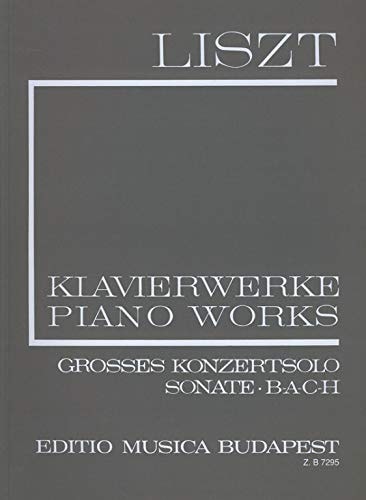
Grosses Konzertsolo, Sonate, B-A-C-H (I/5) (Piano)
0
0
As an Amazon Associate and affiliate partner, Menrva Books earns from qualifying purchases. Learn more
Author Description
Liszt wrote the Grosses Konzertsolo in 1849-50 for a piano competition at the Paris Conservatoire, and dedicated it to Adolf Henselt. In this work Liszt was experimenting with new means of expression. According to his memoirs, the work was so difficult that even Henselt could not manage it, and the premiere was given by Tausig. The dedication of the Sonata (Liszt's only extant work with this title and form) is to Schumann, who had, long beforehand, dedicated his C major Fantasy to Liszt. The Sonata forms a pair to the Faust symphony, and thematic similarities can be detected between the two works. The B-A-C-H Fantasy and Fugue was originally written for organ. The work was intended to be played at the inauguration of the new organ in the Merseburg Cathedral, but Liszt did not complete it in time, so the premiere did not take place until half a year later. Liszt also transcribed the work for piano, then later revised both the piano and the organ versions. The main part of the volume contains the second version for piano, and in the appendix can be found the first version for piano.As customary, there are two versions of the publication: a blue clothbound edition and a grey softcover edition. The preface, which gives the most important information on the contents and technical details, is identical in both versions, but only the former includes an English description of the sources and a critical commentary. Both versions include facsimiles of pages from Liszt's original autograph manuscript.Works marked by an asterisk in the Contents are published here for the first time in print.Hungaroton HCD 12769
Menrva's Summary
THE THESIS
This volume investigates the compositional history and technical evolution of three significant keyboard works by Franz Liszt: the Grosses Konzertsolo, the Sonata in B minor, and the Fantasy and Fugue on the theme B-A-C-H. The editor, Antal Pál Boronkay, provides a critical examination of these scores, tracing their origins, performance histories, and the specific revisions Liszt applied to his piano and organ transcriptions.
THE SCOPE MAP
What You Will Find
- Detailed historical context regarding the composition of the Grosses Konzertsolo and the Sonata in B minor.
- Comparative analysis of the first and second versions of the B-A-C-H Fantasy and Fugue for piano.
- Facsimiles of pages from Liszt's original autograph manuscripts.
- Critical commentary on source materials and performance challenges.
Scope Limits
- The volume focuses exclusively on these three specific works and does not provide a comprehensive survey of Liszt's entire piano repertoire.
- The English-language critical commentary is restricted to the clothbound edition of the publication.
THE AUTHORITY PERSPECTIVE
Musicologists and performers regard this edition as a reliable resource for studying the evolution of Liszt's keyboard writing. Experts highlight the inclusion of both the primary versions and the appendix materials as a significant aid for scholarly research and informed performance practice.
Page Count:
104
Publication Date:
2000-01-01
Publisher:
Editio Musica Budapest Zeneműkiadó
ISBN-10:
008007295X
ISBN-13:
9780080072951
Music
Musicology
Piano
Music
Sheet Music
Community Tags
Similar Books