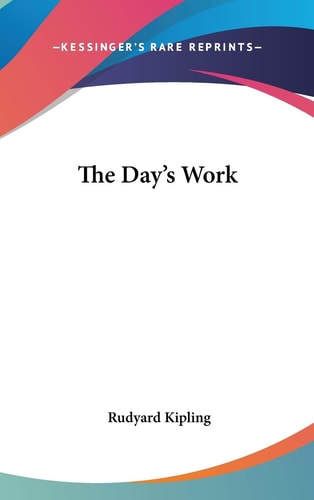
The Day's Work
0
0
As an Amazon Associate and affiliate partner, Menrva Books earns from qualifying purchases. Learn more
Author Description
This collection contains twelve stories that focus on the value of work, the sea, animals, children, England, and America, including "A Walking Delegate," "The Bridge-Builders," "The Tomb of His Ancestors," and "William the Conquerer," among others.
Menrva's Summary
THE PULSE
Rudyard Kipling explores the intersection of human industry, mechanical progress, and the natural world through a series of twelve distinct narratives. Each story functions as a study of professional duty and the physical demands placed upon individuals in various environments, ranging from the high seas to the colonial frontier. The protagonists often face external pressures—be it the construction of massive infrastructure or the navigation of complex social hierarchies—that test their technical competence and moral resolve. Kipling employs a varied narrative framework, utilizing both third-person omniscient perspectives and character-driven accounts to examine the ethos of labor in the late nineteenth century.
INSIDE THE PAGES
- Detailed depictions of engineering and industrial labor
- Exploration of colonial administration and duty
- Anthropomorphic elements in animal-centric narratives
- Focus on the technical aspects of maritime life
- Examination of cultural contrasts between England and America
- Use of regional dialects and professional jargon
- Themes of stoicism and individual responsibility
- Integration of moral fables within realistic settings
THE COLLECTIVE ECHO
Readers frequently highlight the technical precision Kipling brings to his descriptions of machinery and professional trades. Discussion often centers on the author's ability to imbue inanimate objects and infrastructure with a sense of character and purpose. Critics observe that the collection reflects the imperial values of the era, which generates ongoing debate regarding the portrayal of colonial subjects and authority. The pacing is noted for being deliberate, favoring atmospheric detail and thematic development over rapid plot progression. Many readers appreciate the stylistic variety present across the twelve stories, noting that the work serves as a significant window into the period's preoccupation with progress and order.
Page Count:
334
Publication Date:
1987-04-09
Publisher:
Oxford University Press
ISBN-10:
0192817140
ISBN-13:
9780192817143
Adventure
Realism
Classic Literature
Short Stories
British literature