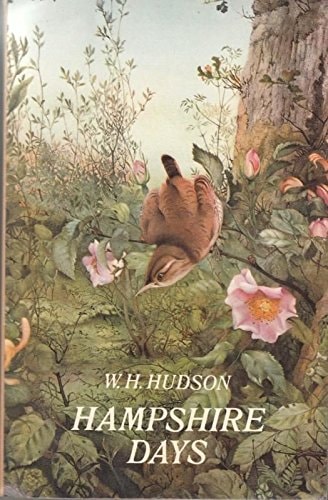
Hampshire Days
0
0
As an Amazon Associate and affiliate partner, Menrva Books earns from qualifying purchases. Learn more
Author Description
This ebook edition has been proofed, corrected and compiled to be read with without errors!***An excerpt from the beginningCHAPTER IAutumn in the New Forest—Red colour in mammals—November mildness—A house by the Boldre—An ideal spot for small birds—Abundance of nests—Small mammals and the weasel’s part—Voles and mice—Hornet and bank-vole—Young shrews—A squirrel’s visit—Green woodpecker’s drumming-tree—Drumming of other species—Beauty of great spotted woodpecker—The cuckoo controversy—A cuckoo in a robin’s nest—Behaviour of the cuckoo—Extreme irritability—Manner of ejecting eggs and birds from the nest—Loss of irritability—Insensibility of the parent robins—Discourse on mistaken kindness, pain and death in nature, the annual destruction of bird life, and the young cuckoo’s instinct.HERE, by chance, in the early days of December 1902, at the very spot where my book begins, I am about to bring it to an end.A few days ago, coming hither from the higher country at Silchester, where the trees were already nearly bare, I was surprised to find the oak woods of this lower southern part of the New Forest still in their full autumnal foliage. Even now, so late in the year, after many successive days and nights of rain and wind, they are in leaf everywhere the woods are yellow, here where the oak predominates; the stronger golden red and russet tints of the beech are vanished. We have rain and wind on most days, or rather mist and rain by day and wind with storms of rain by night; days, too, or parts of days, when it is very dark and still, and when there is a universal greyness in earth and sky. At such times, seen against the distant slaty darkness or in the blue-grey misty atmosphere, the yellow woods look almost more beautiful than in fine weather.The wet woodland roads and paths are everywhere strewn, and in places buried deep in fallen leaves—yellow, red, and russet; and this colour is continued under the trees all through the woods, where the dead bracken has now taken t
Menrva's Summary
THE THESIS
This work investigates the ecological rhythms and biological diversity of the New Forest region in Hampshire through the lens of direct observation. W. H. Hudson, a naturalist and author known for his keen observational skills, utilizes his personal experiences and field notes from the early 20th century to document the behavior of local fauna. He presents a framework that emphasizes the interconnectedness of species and the cyclical nature of the English countryside.
THE SCOPE MAP
What You Will Find
- Detailed observations of avian behavior, specifically focusing on woodpeckers and cuckoos.
- Analysis of small mammal populations, including voles, mice, and shrews.
- Descriptive accounts of the seasonal transitions in the New Forest landscape.
- Philosophical reflections on the nature of predation and survival in the wild.
Scope Limits
- The text does not provide a comprehensive scientific survey or statistical data set.
- It focuses primarily on a specific geographic region in Southern England rather than a broader national analysis.
THE AUTHORITY PERSPECTIVE
Naturalists and literary critics often praise Hudson for his evocative prose and his ability to capture the atmosphere of the English landscape. Readers frequently note that while the text is accessible, it reflects the observational style of early 20th-century natural history writing rather than modern empirical research methods.
Page Count:
250
Publication Date:
1980-01-01
Publisher:
Oxford University Press
ISBN-10:
019281298X
ISBN-13:
9780192812988
Nature
Travel
Natural History
Natural history
Essays
Ornithology
British literature
Community Tags
Similar Books