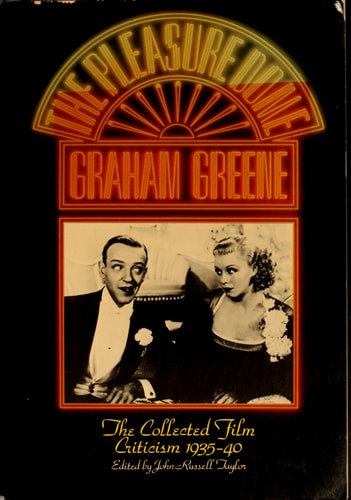
The Pleasure Dome: Graham Greene - The Collected Film Criticism 1935-1940
0
0
As an Amazon Associate and affiliate partner, Menrva Books earns from qualifying purchases. Learn more
Author Description
'Four and a half years of watching films several times a week... I can hardly believe in that life of the distant thirties now, a way of life which I adopted quite voluntarily from a sense of fun.' So begins Graham Greene's Introduction to this collection of his film reviews for The Spectator and the distinguished, ill-fated magazine Night and Day between 1935 and 1940. During these years he was also writing such unforgettable novels as Brighton Rock, The Power and the Glory, and A Gun for Sale, and for readers of Graham Greene's novels this volume carries a real bonus, revealing as much about Greene the man and his creative processes as it does about the films he writes on.But Greene the film critic would be well worth reading even if he were not Greene the novelist as well. Here he writes on Garbo at the peak of her career, on the best of the British documentary movement, on films by Buñuel, Capra, Hitchcock, Korda, Lubitsch, Renoir, and many others. But he also relishes the cinema for itself, at its most popular; he praises the anarchic early Marx Brothers films, Fred Astaire in Top Hat, and W. C. Fields.There are insights and quotable phrases on every page of this irresistible collection, and Greene's asides on contemporary developments in the late 30s give an additional interest to these reviews. There are reviews of propaganda films, discussions of censorship and references to contemporary cultural events (Greene fantasises, in a 1937 review of A Day at the Races, about taking Maureen O'Sullivan to the new Surrealist Exhibition).This collection is packed with contemporary film stills – many of them given double-page spreads – and is a delight to browse in. There is an appendix on the famous libel case following Greene's review of Shirley Temple in Wee Willie Winkie, and Greene's Introduction to the volume not only puts his career as a film reviewer in perspective, but also contains some splendid anecdotes.
Menrva's Summary
THE THESIS
This collection investigates the intersection of popular cinema and cultural commentary during the late 1930s through the lens of a prominent novelist. Graham Greene, already an established literary figure, provides a retrospective analysis of his own critical output for The Spectator and Night and Day. The volume argues that film criticism serves as a vital window into both the aesthetic evolution of the medium and the personal creative development of the critic himself.
THE SCOPE MAP
What You Will Find
- A comprehensive archive of film reviews published between 1935 and 1940.
- Commentary on major directors including Hitchcock, Renoir, Capra, and Buñuel.
- Analysis of the British documentary movement and early Hollywood studio productions.
- Primary source documentation regarding the legal libel case involving Shirley Temple.
Scope Limits
- The collection does not extend beyond the 1935-1940 period.
- It does not provide a formal academic history of cinema, focusing instead on subjective contemporary reaction.
THE AUTHORITY PERSPECTIVE
Critics and scholars frequently cite this volume as a primary source for understanding the intersection of literary sensibility and mid-century film culture. Readers often note the sharp, acerbic wit of Greene's prose, which remains accessible even to those unfamiliar with the specific films reviewed.
Page Count:
288
Publication Date:
1980-05-01
Publisher:
Oxford University Press
ISBN-10:
0192812866
ISBN-13:
9780192812865
Non-Fiction
Biography
Cultural History
Essays
Film Criticism
Motion pictures
Journalism
Community Tags
Similar Books