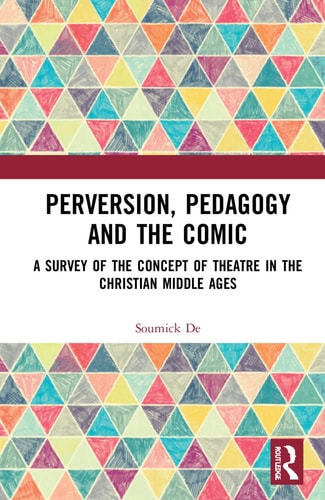
Perversion, Pedagogy and the Comic A Survey of the Concept of Theatre in the Christian Middle Ages
0
0
As an Amazon Associate and affiliate partner, Menrva Books earns from qualifying purchases. Learn more
Author Description
Perversion, Pedagogy and the Comic studies how the idea-of-theater shaped western consciousness during the Christian Middle Ages. It analyses developments within western philosophy, Christian theology and theater history to show how this idea realized itself primarily as a metaphor circulating through various discursive domains. Beginning with Plato's injunction against tragedy the relation between philosophy and theater has been a complicated affair which this book traces at the threshold when the western world became Christian. By late antiquity as theatre was slowly banned, Christian theology put the idea-of-theatre to use in order to show what they understood to be the perverted nature of worldly existence and the mystery of the Kingdom of God. Interrogating the theological teachings of some of the early Church Fathers like St Augustine, Tertullian and Clement of Alexandria the book offers a new look at how the idea of theater not only inspired Christian liturgical practices but Christian pedagogy in general which in turn shaped the nature of Christian religious drama. Finally the author tries to demonstrate how this hegemonic use of the theatre-idea was countered by a certain comic sensibility which opened the idea of theatre in the Christian Middle Ages to a new and subversive materialist possibility. Please note: Taylor & Francis does not sell or distribute the Hardback in India, Pakistan, Nepal, Bhutan, Bangladesh and Sri Lanka.
Menrva's Summary
THE THESIS
This book investigates how the concept of theater profoundly influenced Western consciousness during the Christian Middle Ages, particularly at the intersection of philosophy, theology, and dramatic history. Soumick De, drawing on developments in Western philosophy, Christian theology, and theater history, analyzes how the 'idea-of-theater' functioned as a pervasive metaphor. The study begins by examining Plato's critique of tragedy and traces its complex relationship with philosophy as the Western world transitioned to Christianity. It then explores how, as theater was increasingly banned in late antiquity, Christian theology adopted the 'idea-of-theatre' to articulate the perceived perversion of worldly existence and the divine mystery of God's Kingdom.
THE SCOPE MAP
- Analysis of the relationship between philosophy and theater from Plato to the Christian Middle Ages.
- Examination of how Christian theology utilized the concept of theater to describe worldly existence and the Kingdom of God.
- Interrogation of theological teachings from early Church Fathers such as St. Augustine, Tertullian, and Clement of Alexandria.
- Exploration of the influence of the 'idea of theater' on Christian liturgical practices and pedagogy.
- Demonstration of how the concept of theater inspired Christian religious drama.
- Argument for a comic sensibility that offered a subversive, materialist interpretation of theater in the Middle Ages.
THE AUTHORITY PERSPECTIVE
The book's detailed examination of theological and philosophical texts suggests a scholarly approach, likely appealing to academics and students specializing in medieval history, religious studies, and theater history. The focus on the conceptualization of theater rather than performance itself indicates a work of intellectual history. The author's engagement with early Church Fathers and the concept of perversion points to a nuanced exploration of how religious doctrine shaped cultural ideas. The concluding argument about a comic sensibility offers a potentially novel perspective on the period's theatrical thought.
Page Count:
430
Publication Date:
2022-01-01
Publisher:
Taylor & Francis Group
ISBN-10:
1032292156
ISBN-13:
9781032292151
History
Non-Fiction
Philosophy
Theater History
Community Tags
Similar Books