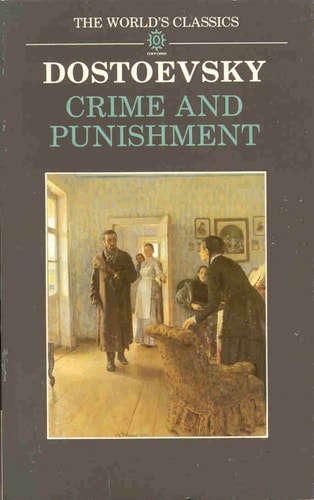
Crime and Punishment
0
0
As an Amazon Associate and affiliate partner, Menrva Books earns from qualifying purchases. Learn more
Author Description
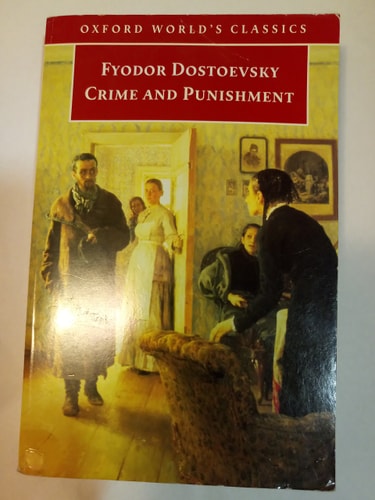
'I wanted to make myself a Napoleon,' states Raskolnikov, 'and that is why I killed her.'Crime and Punishment is the story of a murder committed on principle, of a killer who wishes by his action to set himself outside and above society. A novel of fearful tension, physical and psychological--will Raskolnikov be trapped in the upstairs room holding the bloody axe?--will his image of himself as a superman crack under the pressure of the law and of his own conscience?--it is pervaded by Dostoevsky's sinister evocation of St Petersburg, yet the life of its gloomy tenements and drink-shops provides moments of wild humour.Crime and Punishment was marked by Dostoevsky's own harrowing experiences. He had himself as a young man undergone interrogation and trial, and was condemned to death, a sentence commuted to penal servitude. In prison he was particularly impressed by one hardened murderer who seemed to have attained a spiritual equilibrium beyond good and evil: yet witnessing the misery of other convicts engendered in Dostoevsky a belief in the Christian idea of salvation through suffering, embodied in Crime and Punishment in the figure of Sonya, the 'pure prostitute' whom Raskolnikov befriends.
Menrva's Summary
THE PULSE
Rodion Raskolnikov, an impoverished former student in St. Petersburg, commits a brutal murder to test his theory that extraordinary individuals are exempt from moral law. Raskolnikov struggles to reconcile his intellectual justification for the crime with the mounting psychological torment and paranoia that follow his actions. He is pursued by the relentless investigator Porfiry Petrovich, whose cat-and-mouse interrogation techniques push Raskolnikov toward a breaking point. The narrative utilizes a third-person limited perspective to immerse the reader in the protagonist's feverish mental state, set against the backdrop of a decaying, claustrophobic urban environment.
INSIDE THE PAGES
- Intense psychological interiority focusing on the protagonist's moral decay
- Vivid, atmospheric depiction of 19th-century St. Petersburg
- Philosophical exploration of utilitarianism and the 'superman' concept
- Thematic focus on guilt, redemption, and the necessity of suffering
- Complex, multi-layered dialogue during interrogation scenes
- Contrast between the squalor of tenements and the intellectual heights of the protagonist
- Symbolism involving religious iconography and the figure of the 'pure prostitute'
- Non-linear progression of the protagonist's mental breakdown
THE COLLECTIVE ECHO
Readers and critics frequently highlight the novel's unparalleled ability to map the internal landscape of a guilty conscience. Discussion often centers on the tension between Raskolnikov's cold, rationalized philosophy and his visceral, human reaction to his own actions. Many observers note that the pacing is deliberately slow and suffocating, mirroring the protagonist's own entrapment within his thoughts. The character of Sonya is often cited as a pivotal counterpoint to Raskolnikov, representing the possibility of spiritual rebirth through humility. The work remains a primary reference point for discussions regarding the intersection of ethics, law, and individual morality.
Page Count:
560
Publication Date:
1981-05-21
Publisher:
Oxford University Press
ISBN-10:
0192815490
ISBN-13:
9780192815491
Crime
Philosophical
Classic Literature
Psychological
Russian
Saint petersburg russia fiction