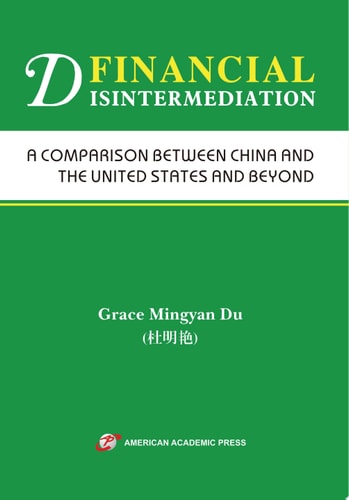
Financial Disintermediation: A Comparison Between China and the United States and Beyond
0
0
As an Amazon Associate and affiliate partner, Menrva Books earns from qualifying purchases. Learn more
Author Description
With historical and comparative method, this book explores financial disintermediation which besets both the United States and China and extends the thinking up to the evolutional trend of capitalism and socialism. Different from the previous research, this book delves into the first cause which induces financial disintermediation, namely the basic deficiency of capitalism: liquidity crisis, and the countermeasures which various institutional systems have taken for dealing with it. The conclusion reveals that the upheaval was initiated from the founding of financial safety net. During the Great Depression, by adopting financial safety net, the previous evolving track of American financial system was ended, and a new path launched – financial disintermediation. The starting point for China was the setout of “the reform and opening-up”. In the West, financial safety net formulates a dualistic regulatory regime, which spurred financial disintermediation. Severe financial disintermediation has led up to a series of thorny issues, including the resurgence of liquidity crisis, the financialization of the economy, and too-big-to-fail, and debt overhang and widening wealth disparity and so on. In China, the main difference with its western counterpart should be the replacement of asset quality deterioration in financial system to liquidity crisis. The root problem lies in that some matched institutions needed for guaranteeing its positive effects are desperately absent or weak, so it is a must to strengthen them, and steadfastly arrest financial disintermediation simultaneously. For that, both regimes should learn from each other.
Menrva's Summary
THE THESIS
This book investigates the phenomenon of financial disintermediation and its causes and consequences in both China and the United States, extending the analysis to the broader evolution of capitalism and socialism. The author, Grace Mingyan Du, employs a historical and comparative method to explore the fundamental deficiency of capitalism—the liquidity crisis—as the primary driver of financial disintermediation. The work examines the countermeasures implemented by various institutional systems, particularly focusing on how the establishment of financial safety nets, beginning with the Great Depression in the US and the reform and opening-up in China, altered their respective financial systems. The book argues that these safety nets, while intended to stabilize, have paradoxically spurred disintermediation, leading to issues like resurgent liquidity crises, economic financialization, and wealth disparity.
THE SCOPE MAP
- Exploration of financial disintermediation in the United States and China using historical and comparative methods.
- Analysis of the liquidity crisis as the root cause of financial disintermediation in capitalist systems.
- Examination of institutional countermeasures adopted by various systems to address financial disintermediation.
- Discussion of how the founding of financial safety nets, particularly during the Great Depression in the US, initiated financial disintermediation.
- Analysis of China's 'reform and opening-up' as a starting point for its financial disintermediation.
- Identification of the dualistic regulatory regime in the West as a spur for financial disintermediation.
- Discussion of consequences such as resurgent liquidity crises, economic financialization, 'too-big-to-fail' issues, debt overhang, and wealth disparity.
- Comparison of the Chinese context, highlighting asset quality deterioration as a primary issue instead of liquidity crisis, and the need for strengthening absent or weak institutions.
THE AUTHORITY PERSPECTIVE
The book offers a detailed comparative analysis of financial disintermediation in China and the United States, examining its roots in capitalist liquidity crises and the role of financial safety nets. It posits that these safety nets, while intended to stabilize, have paradoxically driven disintermediation, leading to significant economic challenges. The author's research suggests that while both nations face these issues, China's experience is marked by asset quality deterioration rather than pure liquidity crisis, necessitating specific institutional strengthening. The work advocates for mutual learning between the two regulatory regimes to effectively manage and arrest financial disintermediation.
Page Count:
237
Publication Date:
2023-01-02
Publisher:
American Academic Press
ISBN-10:
1631815776
ISBN-13:
9781631815775
Non-Fiction
Economics
Socialism
Finance
Comparative Studies
Capitalism
Community Tags
Similar Books