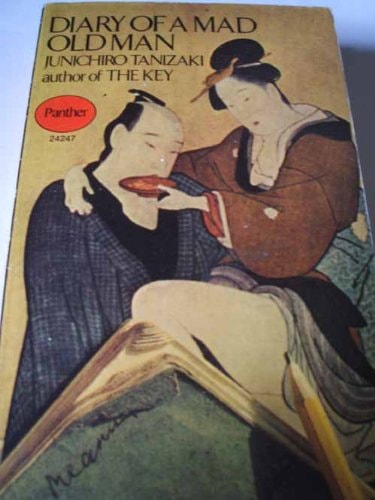
Diary of a Mad Old Man
0
0
As an Amazon Associate and affiliate partner, Menrva Books earns from qualifying purchases. Learn more
Author Description
The last novel by one of the best-known Japanese writers, Junichiro Tanizaki who died in 1965 at the age of 79. Tanizaki studied Japanese literature at Tokyo Imperial University and in his youth he was strongly influenced by Poe, Baudelaire and Oscar Wilde, but after the earthquake of 1923 he moved to the gentler, more cultured Kyoto region and there became absorbed in the Japanese past and abandoned his superficial Westernization. By 1930 he had gained such recognition that his "Complete works" were published. In spite of illness in the last years of his life, his mind remained as alert as ever, and during this period he wrote of unusual sexual and psychological problems in "The key" (published in this country in 1961) and "Diary of a mad old man". This book has been accepted in the Japanese Translations Series of the United Nations Education, Scientific and Cultural Organization. Tanizaki was awarded the Imperial Award for Cultural Merit in 1949 and was elected an Honorary Member of the American Academy and the National Institute of Arts and Letters in 1964.
Menrva's Summary
THE PULSE
An aging man confronts the decline of his physical health while becoming increasingly obsessed with his daughter-in-law. The protagonist, Utsugi, records his intimate thoughts and desires in a private journal as he navigates the constraints of his failing body and the social expectations of his family. His fixation on Satsuko, his daughter-in-law, serves as the primary catalyst for the narrative, creating a tense domestic atmosphere. The story utilizes an epistolary framework, allowing the reader direct access to the protagonist's internal rationalizations and moral conflicts.
INSIDE THE PAGES
- Epistolary narrative structure presented as a personal diary
- Exploration of the intersection between physical decay and sexual obsession
- Examination of traditional Japanese family dynamics
- Introspective character study of an aging patriarch
- Contrast between the protagonist's internal desires and external social decorum
- Clinical observation of psychological fixation
- Minimalist setting focused on the domestic sphere
- Unreliable narration through the lens of a biased protagonist
THE COLLECTIVE ECHO
Readers and critics frequently discuss the clinical precision with which Tanizaki dissects the protagonist's obsession. The narrative is often noted for its unflinching look at the intersection of mortality and desire, avoiding sentimentality in favor of psychological realism. Discussion often centers on the unsettling nature of the protagonist's perspective and how it challenges the reader's empathy. Many highlight the author's ability to maintain a controlled, detached tone even when describing highly volatile internal states. The work remains a significant point of reference for those interested in the complexities of late-career literary output.
Page Count:
178
Publication Date:
1988-01-01
Publisher:
Oxford University Press
ISBN-10:
0192821377
ISBN-13:
9780192821379
Literary Fiction
Contemporary Classics
Psychological