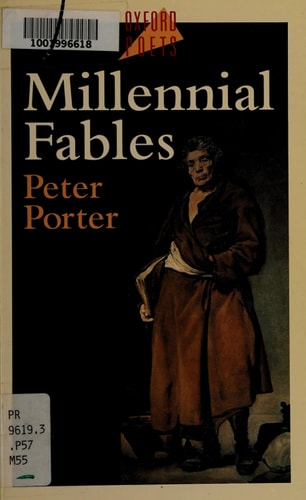
Millennial Fables
0
0
As an Amazon Associate and affiliate partner, Menrva Books earns from qualifying purchases. Learn more
Author Description
In the countdown to the Third Millennium, time and events tend to be scrutinized apprehensively. Ordinary human fear of portents and oracles becomes intensified. Peter Porter's new collection acknowledges this pressure, and protests against it. More than ever, his poems address contemporary life in its present flux, while forecasting a turbulent future. The second part of the book, entitled "Homage to Robert Browning," is a series of monologues and character pieces in which individual voices speak to us from a wide range of occasions and places. An imaginary notebook kept by Bach's first wife Maria, Barbara, and poems called "Aesop's Dressing Gown," and "Berenson Spots a Lotto," all give an idea of Porter's wide-ranging curiosity and knowledge, which he displays wit great generosity and humor.
Menrva's Summary
THE PULSE
Peter Porter examines the anxieties surrounding the turn of the millennium through a collection of poems that challenge the human tendency to seek meaning in portents and oracles.
The poet navigates the tension between contemporary life in flux and the anticipation of a turbulent future. Through a blend of direct social commentary and imaginative character studies, Porter explores the intersection of historical perspective and modern apprehension. The narrative framework shifts between the poet's own voice and a series of dramatic monologues, grounding abstract fears in specific, often historical, contexts.
INSIDE THE PAGES
- Dramatic monologues featuring diverse historical and fictional personas
- Satirical commentary on the human obsession with prophecy
- Intertextual references to classical literature and historical figures
- Exploration of the transition between the second and third millennium
- Character-driven vignettes including the perspective of Maria Barbara Bach
- Philosophical inquiries into the nature of time and memory
- Use of wit and humor to address existential dread
- Stylistic variety ranging from observational poetry to structured character pieces
THE COLLECTIVE ECHO
Readers and critics frequently highlight Porter's ability to balance intellectual rigor with accessible, often humorous, observations on the human condition. Discussion often centers on the effectiveness of his dramatic monologues, which allow him to inhabit disparate voices while maintaining a cohesive thematic focus on the anxiety of the era. The collection is noted for its wide-ranging curiosity, as Porter moves effortlessly between historical figures and contemporary concerns. Critics often point to the poet's refusal to succumb to the apocalyptic fervor of the time, choosing instead to offer a measured and witty critique of such trends. The work is generally regarded as a significant contribution to late twentieth-century poetry, valued for its technical precision and thematic depth.
Page Count:
96
Publication Date:
1995-02-02
Publisher:
Oxford University Press
ISBN-10:
0192823914
ISBN-13:
9780192823915
Poetry
Satire
British literature
Contemporary Poetry
Literary Criticism
Community Tags
Similar Books