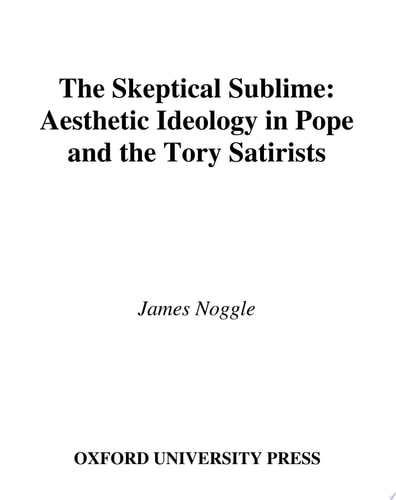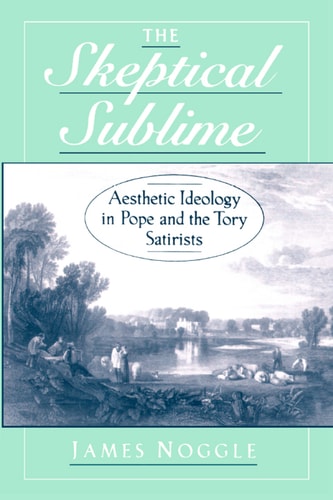
The Skeptical Sublime: Aesthetic Ideology in Pope and the Tory Satirists
0
0
As an Amazon Associate and affiliate partner, Menrva Books earns from qualifying purchases. Learn more
Author Description
This book argues that philosophical skepticism helps define the aesthetic experience of the sublime in late seventeenth- and eighteenth-century British literature, especially the poetry of Alexander Pope. Skeptical doubt appears in the period as an astonishing force in discourse that cannot be controlled--"doubt's boundless Sea," in Rochester's words--and as such is consistently seen as affiliated with the sublime, itself emerging as an important way to conceive of excessive power in rhetoric, nature, psychology, religion, and politics. This view of skepticism as a force affecting discourse beyond its practitioners' control links Noggle's discussion to other theoretical accounts of sublimity, especially psychoanalytic and ideological ones, that emphasize the sublime's activation of unconscious personal and cultural anxieties and contradictions. But because The Skeptical Sublime demonstrates the sublime's roots in the epistemological obsessions of Pope and his age, it also grounds such theories in what is historically evident in the period's writing. The skeptical sublime is a concrete, primary instance of the transformation of modernity's main epistemological liability, its loss of certainty, into an aesthetic asset--retaining, however, much of the unsettling irony of its origins in radical doubt. By examining the cultural function of such persistent instability, this book seeks to clarify the aesthetic ideology of major writers like Pope, Swift, Dryden, and Rochester, among others, who have been seen, sometimes confusingly, as both reactionary and supportive of the liberal-Whig model of taste and civil society increasingly dominant in the period. While they participate in the construction of proto-aesthetic categories like the sublime to stabilize British culture after decades of civil war and revolution, their appreciation of the skepticism maintained by these means of stabilization helps them express ambivalence about the emerging social order and distinguishes t
Menrva's Summary
THE THESIS
This book investigates how philosophical skepticism functions as a foundational element in the aesthetic experience of the sublime within late seventeenth- and eighteenth-century British literature. James Noggle, an academic specializing in the period, utilizes a framework that bridges epistemological history and aesthetic theory to analyze the works of Alexander Pope and his contemporaries. He argues that the era's pervasive loss of certainty was transformed into an aesthetic asset, allowing writers to express deep-seated ambivalence toward the emerging liberal-Whig social order.
THE SCOPE MAP
What You Will Find
- Analysis of the relationship between radical doubt and the sublime in rhetoric, nature, and politics.
- Examination of the works of Alexander Pope, Jonathan Swift, John Dryden, and the Earl of Rochester.
- Theoretical synthesis connecting historical epistemological concerns with modern psychoanalytic and ideological interpretations of sublimity.
Scope Limits
- The study focuses primarily on the Tory satirists and does not provide an exhaustive survey of all eighteenth-century aesthetic thought.
- The analysis is restricted to the specific intersection of skepticism and the sublime rather than a general history of the period's literature.
THE AUTHORITY PERSPECTIVE
Scholars frequently cite this work as a significant contribution to the study of eighteenth-century aesthetic ideology and the intellectual history of the period. Readers often note the academic density of the prose, which is intended for an audience familiar with both literary theory and the political history of the Enlightenment.
Page Count:
283
Publication Date:
2001-01-01
Publisher:
Oxford University Press
ISBN-10:
0190286555
ISBN-13:
9780190286552
Philosophy
Satire
British literature
Great Britain
Literary Criticism
Aesthetics
18th century
English & College Success
English
Community Tags
Similar Books