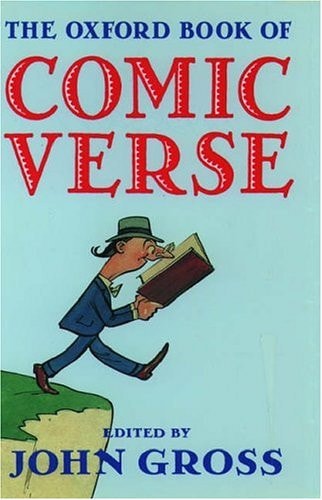
The Oxford Book of Comic Verse
0
0
As an Amazon Associate and affiliate partner, Menrva Books earns from qualifying purchases. Learn more
Author Description
"Comic verse," writes editor John Gross, "is verse that is designed to amuse--and perhaps that is as far as any attempt at a definition ought to go." In The Oxford Book of Comic Verse, Gross has combed the annals of literature in English from the middle ages to the present, gathering poems that provoke laughter, smiles, and even reflections on the human condition--but always poems that amuse.From limericks to social satire, The Oxford Book of Comic Verse offers a remarkable collection of outstanding light poetry. Gross has brought together the finest writers in the history of the English language--from Chaucer and Skelton to Shakespeare and Swift, Lord Byron to Robert Browning, Emily Dickinson to John Updike--offering delightful examples of their comic verse. Many of these lines dance with whimsy, such as John Skelton's Colin Clout ("For though my rhyme be ragged,/ Tattered and jagged,/ Rudely rain-beaten,/ Rusty and moth-eaten,/ If ye take well therewith,/ It hath in it some pith"); others float heavier thoughts on light rhymes--as in Matthew Prior's succinct Human Life ("What trifling coil do we poor mortals keep;/ Wake, eat, and drink, evacuate and sleep."). The range of writers who have composed comic verse is astonishing, as is the delight of the poems themselves. Here we read T.S. Eliot mocking himself ("How unpleasant to meet Mr. Eliot!/ With his features of clerical cut"); poet and Soviet historian Robert Conquest, mingling his two professions in a limerick ("There was a great Marxist called Lenin/ Who did two or three million men in/ --That's a lot to have done in/ --But where he did one in/ That grand Marxist Stalin did ten in"); and Wendy Cope commenting on her disillusionment with poets ("I used to think all poets were Byronic./ They're mostly wicked as ginless tonic/ And wild as pension plans"). And along the way, we are treated to witty song lyrics as well, from First World War soldiers' tunes, to Irving Berlin, to Cole Porter, to Lorenz Hart ("When lo
Menrva's Summary
THE THESIS
What defines the boundaries of humor within the formal constraints of verse? Editor John J. Gross, a distinguished literary critic and historian, compiles a vast array of English-language poetry to investigate the mechanics of amusement, satire, and wit across several centuries of literary production.
THE SCOPE MAP
What You Will Find
- A chronological selection of comic verse spanning from the Middle Ages to the late 20th century.
- Examples of diverse forms including limericks, social satire, and witty song lyrics.
- Inclusion of canonical authors such as Chaucer, Shakespeare, and Swift alongside modern figures like T.S. Eliot and Wendy Cope.
Scope Limits
- The collection does not provide an exhaustive history of every comic poet in the English language.
- The analysis does not focus on technical prosody or the structural evolution of poetic meter.
THE AUTHORITY PERSPECTIVE
Critics frequently note the breadth of the selection, praising Gross for balancing high-brow satire with accessible, lighthearted whimsy. Scholars often highlight this volume as a standard reference for those interested in the lighter side of the English poetic tradition.
Page Count:
560
Publication Date:
1996-01-04
Publisher:
Oxford University Press
ISBN-10:
0192832077
ISBN-13:
9780192832078
Humor
Poetry
Classic Literature
Anthology
Literary Criticism
Community Tags
Other Editions(2)
Similar Books
Reader Comments
Share Your Thoughts
No comments yet. Be the first to share your thoughts!