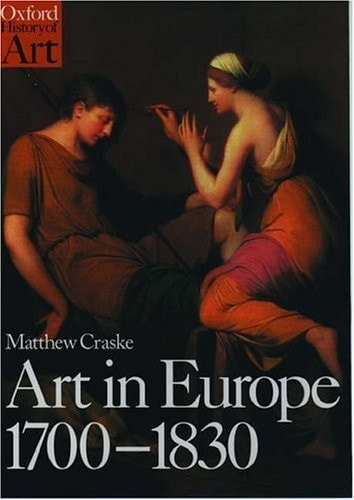
Art in Europe 1700-1830
0
0
As an Amazon Associate and affiliate partner, Menrva Books earns from qualifying purchases. Learn more
Author Description
In an era of unprecedented change--rapid urbanization, economic growth, and political revolution--European artists from 1700-1830 were in the business of finding new ways of making, selling, and talking about art. Matthew Craske creates a totally new and vivid record of eighteenth- and early nineteenth-century art in Europe, taking a critical view of such conventional categories as the "rococo," the "neo-classical," and the "romantic." He goes on to explore crucial thematic issues, such as changes in "taste" and manners, and the impact of enlightenment notions of progress, and at the same time goes well beyond the usual geographic limits of surveys to include St. Petersburg, Copenhagen, Warsaw, and Madrid. The result is a refreshingly holistic text which sets the art of the period firmly in its social history.
Menrva's Summary
THE THESIS
This work investigates how European art between 1700 and 1830 evolved in response to rapid urbanization, economic shifts, and political revolutions. Matthew Craske, an expert in eighteenth-century art, challenges traditional stylistic classifications like "rococo" and "neo-classical" by situating artistic production within its broader social and intellectual context. He argues that the period's art was fundamentally shaped by Enlightenment ideals and changing notions of taste, providing a framework that integrates aesthetic development with historical progress.
THE SCOPE MAP
What You Will Find
- Analysis of artistic production across diverse European centers including St. Petersburg, Copenhagen, Warsaw, and Madrid
- Critical evaluation of conventional art historical categories
- Examination of the intersection between art, social manners, and economic growth
Scope Limits
- Does not focus exclusively on the traditional artistic hubs of Paris, London, and Rome
- Avoids a purely formalist or stylistic analysis in favor of a social history approach
THE AUTHORITY PERSPECTIVE
Scholars and students of art history frequently cite this text for its ability to synthesize complex social history with aesthetic analysis. Experts highlight the book as a valuable resource for those seeking to move beyond traditional, narrow definitions of eighteenth-century art movements.
Page Count:
320
Publication Date:
1997-05-08
Publisher:
Oxford University Press
ISBN-10:
0192842463
ISBN-13:
9780192842466
Non-Fiction
European History
Social History
18th century
Art
19th Century
Art History
Art european