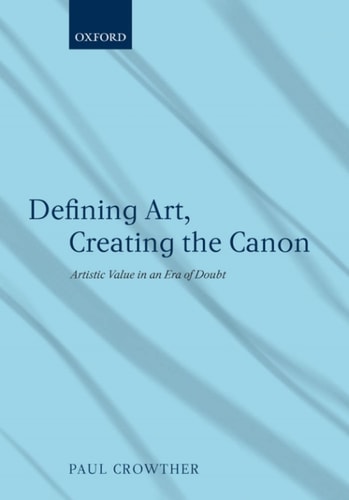
Defining Art, Creating the Canon: Artistic Value in an Era of Doubt
0
0
As an Amazon Associate and affiliate partner, Menrva Books earns from qualifying purchases. Learn more
Author Description
What is art; why should we value it; and what allows us to say that one work is better than another? Traditional answers have emphasized aesthetic form. But this has been challenged by institutional definitions of art and postmodern critique. The idea of distinctively artistic value based on aesthetic criteria is at best doubted, and at worst, rejected. This book, however, champions these notions in a new way. It does so through a rethink of the mimetic definition of art on the basis of factors which traditional answers neglect, namely the conceptual link between art's aesthetic value and 'non-exhibited' epistemological and historical relations. These factors converge on an expanded notion of the artistic image (a notion which can even encompass music, abstract art, and some conceptual idioms). The image's style serves to interpret its subject-matter. If this style is original (in comparative historical terms) it can manifest that special kind of aesthetic unity which we call art. Appreciation of this involves a heightened interaction of capacities (such as imagination and understanding) which are basic to knowledge and personal identity. By negotiating these factors, it is possible to define art and its canonic dimensions objectively, and to show that aforementioned sceptical alternatives are incomplete and self-contradictory.
Menrva's Summary
THE THESIS
This book investigates the possibility of defining art and its canonic dimensions objectively within a contemporary intellectual climate that frequently rejects traditional aesthetic criteria. Paul Crowther, a philosopher specializing in aesthetics and visual culture, challenges institutional and postmodern critiques of art by proposing a revised mimetic definition. He argues that artistic value is fundamentally linked to epistemological and historical relations, asserting that original style facilitates a unique aesthetic unity that connects to human knowledge and personal identity.
THE SCOPE MAP
What You Will Find
- A re-evaluation of the mimetic definition of art incorporating non-exhibited epistemological factors.
- An expanded framework for the artistic image that includes abstract art, music, and conceptual idioms.
- A philosophical argument for the objective nature of artistic value and canonic status.
Scope Limits
- The text does not provide a historical survey of art movements but focuses strictly on the philosophical definition of art.
- It does not address the sociological or market-driven aspects of the contemporary art world.
THE AUTHORITY PERSPECTIVE
Experts recognize this work as a rigorous contribution to contemporary aesthetic theory that attempts to bridge the gap between traditional formalist values and modern skepticism. Readers frequently note the academic density of the prose, which requires a strong background in philosophical terminology to fully engage with the author's arguments.
Page Count:
232
Publication Date:
2007-01-01
Publisher:
Clarendon Press
ISBN-10:
0191526207
ISBN-13:
9780191526206
Non-Fiction
Philosophy
Art History
Art Theory
Art
Aesthetics
Community Tags
Other Editions(2)
Similar Books