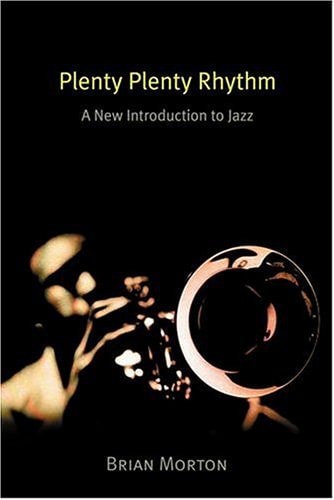
Plenty Plenty Rhythm
0
0
As an Amazon Associate and affiliate partner, Menrva Books earns from qualifying purchases. Learn more
Author Description
Buddy Bolden's legendary wax cylinder recording of 1905. Louis Armstrong in 1928 taking jazz to a level of perfection never to be equaled. Benny Goodman at Carnegie Hall playing a complex blend of blues, Jewish themes, and classical forms. The birth of bebop, a revolutionary form of jazz--complex, difficult, artful, and often antagonistic. John Coltrane takes show tune "My Favorite Things" and turns it into a dark and sinister exercise in musical estrangement. Taking five key moments in jazz history, Brian Morton challenges our assumptions about jazz's origins, its ethnic identity, and its social and political nature. Morton follows jazz as it weaves a constantly evolving tale, full of intriguing sidetracks and occasional dead ends, sudden extinctions and bizarre archaeological survivals. Underneath it, though, there is a constant questioning spirit, an unwillingness to accept orthodoxies, conventional resolutions and simple chronologies. Morton is prompted to ask, at the end of jazz's first century, how can we define a music that embraces both the traditional Dixieland band as well as highly innovative performances that blend pop, classical music, Karelian folk song, and the cool aesthetic of Miles Davis. Does the music have any more than nostalgic connections with its African-American origins? Is there some philosophy or cast of mind which creates jazz? What does it have to do with other, more settled genres, and why do people turn to it? This is a book for jazz lovers ready to reconsider the accepted versions of jazz history, but also for those who have until now looked on
Menrva's Summary
THE THESIS
How can we define a music that embraces such a vast array of styles, from traditional Dixieland to avant-garde fusions, while maintaining its identity? Brian Morton, a seasoned music critic and broadcaster, utilizes five pivotal moments in jazz history to dismantle conventional narratives regarding the genre's origins and social evolution. He argues that jazz is defined not by a static chronology, but by a persistent, questioning spirit that resists orthodoxy and simple categorization.
THE SCOPE MAP
What You Will Find
- Analysis of five key historical milestones, including Buddy Bolden's 1905 recordings and Louis Armstrong's 1928 sessions.
- Examination of the intersection between jazz and diverse cultural influences, such as Jewish themes and Karelian folk music.
- Exploration of the tension between traditionalism and innovation in musical performance.
Scope Limits
- The text does not provide a comprehensive, year-by-year encyclopedia of jazz artists.
- It avoids offering a singular, definitive theory of jazz, focusing instead on the complexity of its development.
THE AUTHORITY PERSPECTIVE
Critics and jazz enthusiasts frequently note the intellectual rigor Morton applies to his analysis of musical history. Experts highlight this as a thought-provoking text for readers who wish to move beyond standard, linear accounts of the genre's development.
Page Count:
176
Publication Date:
2099-11-30
Publisher:
Oxford University Press
ISBN-10:
0192840924
ISBN-13:
9780192840929
Non-Fiction
Music
Jazz
Music History
Community Tags
Similar Books