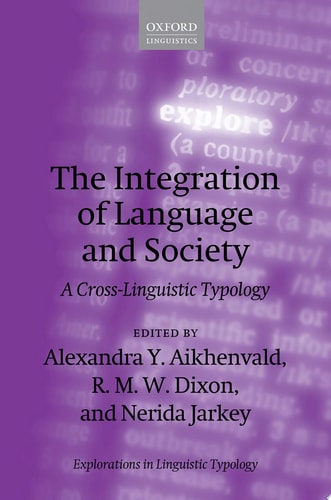
The Integration of Language and Society: A Cross-Linguistic Typology
0
0
As an Amazon Associate and affiliate partner, Menrva Books earns from qualifying purchases. Learn more
Author Description
The volume explores the integration of language and society as reflected in the grammar of a language. Each language bears an imprint of the society that speaks it; language reflects speakers' relationships with each other, their beliefs, and their ways of viewing the world, as well as other aspects of their social environment, their means of subsistence, and even geographical features of the areas in which the language is spoken. The chapters in this book draw on data from the languages of Australia and New Guinea (Dyirbal and Idi), South America (Chamacoco, Ayoreo, Murui, and Tariana), Asia (Japanese, Brokpa, and Dzongkha), and Africa (Iraqw) to examine the ways in which the grammar of a language relates to societal practices. The volume begins with a general introduction that summarizes the main issues relevant to how language and societies are integrated, before later chapters explore specific points of integration in a range of diverse languages, including honorifics, genders and classifiers, possessives, evidentiality, comparatives, and demonstratives. The findings advance our understanding of how non-linguistic traits have their correlates in language, and how these change when society changes. The volume will be a valuable resource for scholars and students of typology, cultural and linguistic anthropology, and sociolinguistics and social sciences more widely.
Menrva's Summary
THE THESIS
This volume investigates the extent to which social structures, cultural beliefs, and environmental factors are encoded within the grammatical systems of diverse languages. The authors, prominent figures in linguistic typology, utilize a comparative framework to argue that language is not an isolated system but a reflection of the social environment, subsistence patterns, and geographical context of its speakers. By examining specific grammatical categories, the text demonstrates how non-linguistic societal traits find direct correlates in linguistic structure.
THE SCOPE MAP
What You Will Find
- Comparative analysis of languages from Australia, New Guinea, South America, Asia, and Africa.
- Examination of specific grammatical features including honorifics, gender systems, classifiers, possessives, evidentiality, and demonstratives.
- A theoretical introduction to the integration of language and society.
Scope Limits
- The text focuses on specific case studies rather than providing an exhaustive global survey of all language families.
- It does not address historical linguistics or language evolution outside the context of social integration.
THE AUTHORITY PERSPECTIVE
Experts identify this volume as a significant contribution to the field of linguistic typology, particularly for its focus on the intersection of grammar and social practice. Scholars frequently note the academic rigor and the breadth of the cross-linguistic data presented, making it a standard reference for researchers in anthropology and sociolinguistics.
Page Count:
408
Publication Date:
2022-02-28
Publisher:
Oxford University Press
ISBN-10:
0192845926
ISBN-13:
9780192845924
Linguistics
Anthropology
Academic
Community Tags
Similar Books