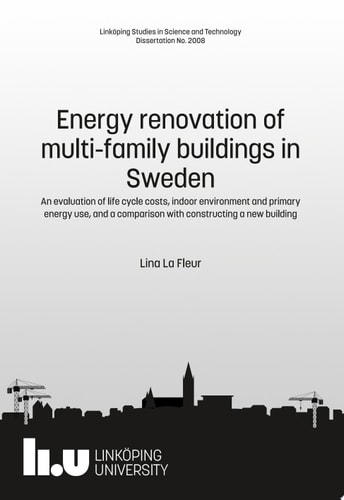
Energy renovation of multi-family buildings in Sweden: An evaluation of life cycle costs, indoor environment and primary energy use, and a comparison with constructing a new building
0
0
As an Amazon Associate and affiliate partner, Menrva Books earns from qualifying purchases. Learn more
Author Description
Residential buildings account for 27% of the final energy use in the European Union. In cold climates, space heating represents the largest proportion of the energy demand in residential buildings. By implementing energy efficiency measures (EEMs) in existing buildings, energy use can be significantly reduced. The Energy Performance of Buildings Directive states that renovations of buildings offer an opportunity to improve energy efficiency. Renovations that include measures implemented with the specific purpose of reducing energy use are referred to as energy renovations. In addition to improving energy efficiency, an energy renovation can also improve the indoor environment. Sweden, like many other European countries, faces the challenge of renovating an ageing building stock with poor energy performance. Improving energy efficiency and performing energy renovations in a cost-effective manner is central, and optimization approaches are often used to identify suitable EEMs and energy renovation approaches. New buildings usually feature better energy performance compared to older buildings, and one approach for reducing energy use in the building sector could be to demolish old buildings with poor thermal performance and build new buildings with better thermal performance. The aim of this thesis is to evaluate energy renovations of multi-family buildings with regard to space heating demand, life cycle costs, indoor environment and primary energy use. The choice between energy renovation of a multi-family building and the demolition and construction of a new one is also investigated with regard to life cycle costs (LCCs). A Swedish multi-family building in which energy renovation has been carried out is used as a case study. The building was originally constructed in 1961 and has a lightweight concrete construction. The renovation included improving the thermal performance of the building envelope and replacing the exhaust air ventilation system with a mecha
Menrva's Summary
THE THESIS
This thesis investigates the economic and environmental viability of energy renovations in Swedish multi-family buildings. The study evaluates life cycle costs, indoor environment quality, and primary energy use associated with these renovations, comparing them against the alternative of demolishing existing structures and constructing new ones. Utilizing a case study of a 1961-built Swedish multi-family building with a lightweight concrete construction, the research examines the impact of improving the building envelope's thermal performance and upgrading ventilation systems. The primary objective is to determine the most cost-effective approach to reducing energy consumption in the residential sector while also considering occupant comfort and long-term sustainability.
THE SCOPE MAP
- Analysis of life cycle costs (LCCs) for energy renovations versus new construction.
- Evaluation of indoor environment conditions post-renovation.
- Assessment of primary energy use reduction through energy efficiency measures (EEMs).
- Case study of a 1961 Swedish multi-family building with lightweight concrete construction.
- Detailed examination of improvements to the building envelope's thermal performance.
- Investigation into the replacement of exhaust air ventilation systems with mechanical systems.
- Comparison of energy renovation strategies with demolition and new building approaches.
THE AUTHORITY PERSPECTIVE
The study addresses a critical challenge in cold climates: the significant energy demand for space heating in residential buildings and the need for cost-effective energy renovations. By focusing on life cycle costs, indoor environment, and primary energy use, the research provides a comprehensive framework for decision-making in the building sector. The comparison between renovating existing multi-family buildings and constructing new ones offers valuable insights for policymakers and developers aiming to improve energy efficiency and sustainability. The detailed case study of a Swedish building grounds the theoretical analysis in practical application.
Page Count:
97
Publication Date:
2019-09-18
Publisher:
Linköping University Electronic Press
ISBN-10:
9176850072
ISBN-13:
9789176850077
Science & Technology
Non-Fiction
Energy Efficiency
Sustainable architecture
Sweden
Building Science
Community Tags
Similar Books

Reader Comments
Share Your Thoughts
No comments yet. Be the first to share your thoughts!