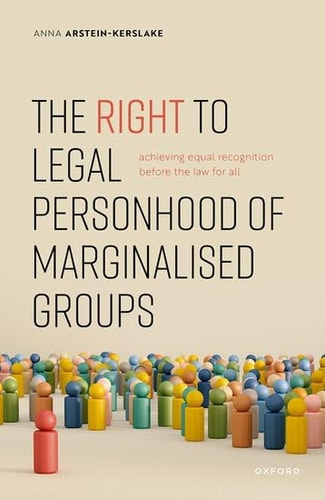
The Right to Legal Personhood of Marginalised Groups: Achieving Equal Recognition Before the Law for All
0
0
As an Amazon Associate and affiliate partner, Menrva Books earns from qualifying purchases. Learn more
Author Description
Legal personhood is required for voting, marrying, inheriting, contracting, consenting, and other critical social acts that can be predicates to power and privilege. The Right to Legal Personhood of Marginalised Groups addresses personhood and legal capacity as human rights issues, in particular as they relate to disabled people, migrant groups, indigenous peoples, racial minorities, women, and gender minorities. The concepts of personhood, legal capacity, and agency have conflicting definitions in the literature, and there is a lack of clarity regarding their application. Dr. Anna Arstein-Kerslake brings her expertise as a renowned thinker in the areas of human rights, disability rights, gender justice, and legal personhood to this discussion. She provides clarity on personhood and legal capacity by developing definitions of these concepts based on the articulation of the right to legal capacity in Article 12 of the United Nations Convention on the Rights of Persons with Disabilities. She then applies these definitions to the situations of various minority groups. The Right to Legal Personhood of Marginalised Groups has the potential to significantly enrich the understanding of how and why marginalised groups are denied equality. It goes beyond the traditional analysis of discrimination and equal protection of the law and explores a new social justice imperative: equal recognition before the law.
Menrva's Summary
THE THESIS
This book investigates how the denial of legal personhood and capacity functions as a systemic barrier to equality for marginalized populations. Dr. Anna Arstein-Kerslake, a specialist in human rights and disability law, utilizes the framework established by Article 12 of the United Nations Convention on the Rights of Persons with Disabilities to clarify the definitions of legal agency. She argues that achieving true equality requires a shift in focus from traditional anti-discrimination measures toward a robust, universal recognition of legal personhood for all individuals.
THE SCOPE MAP
What You Will Find
- Analysis of legal capacity as a human rights imperative
- Application of Article 12 of the UN Convention on the Rights of Persons with Disabilities
- Comparative examination of legal barriers faced by disabled people, migrants, indigenous peoples, and gender minorities
Scope Limits
- The text does not provide a comprehensive history of global legal systems
- It does not offer a step-by-step legislative manual for specific jurisdictions
THE AUTHORITY PERSPECTIVE
Legal scholars and human rights practitioners identify this work as a significant contribution to the discourse on legal agency and social justice. Experts frequently note the clarity with which the author synthesizes complex international human rights standards into a practical framework for advocacy.
Page Count:
160
Publication Date:
2024-11-22
Publisher:
Oxford University Press
ISBN-10:
019284394X
ISBN-13:
9780192843944
Disability
Sociology
Systems Theory
Human rights
Specialties
Law
Social justice
Community Tags
Similar Books