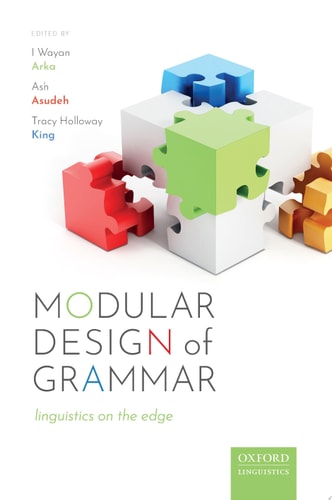
Modular Design of Grammar
0
0
As an Amazon Associate and affiliate partner, Menrva Books earns from qualifying purchases. Learn more
Author Description
This volume presents the latest research in linguistic modules and interfaces in Lexical-Functional Grammar (LFG). LFG has a highly modular design that models the linguistic system as a set of discreet submodules that include, among others, constituent structure, functional structure, argument structure, semantic structure, and prosodic structure; each module has its own coherent properties and is related to other modules by correspondence functions.Following a detailed introduction, Part I examines the nature of linguistic structures, interfaces, and representations in LFG's architecture and ontology. Parts II and III are concerned with problems, analyses, and generalizations associated with linguistic phenomena of long-standing theoretical significance, including agreement, reciprocals, possessives, reflexives, raising, subjecthood, and relativization, demonstrating how these phenomena can be naturally accounted for within LFG's modular architecture. Part IV explores issues of the synchronic and diachronic dynamics of syntactic categories in grammar, such as unlike category coordination, fuzzy categorial edges, and consequences of decategorialization, providing explicit LFG solutions to such problems, including those resulting from language change in progress. The final part re-examines and refines the precise representations and interfaces of syntax with morphology, semantics, and pragmatics to account for challenging facts such as suspended affixation, prosody in multiple question word interrogatives and information structure, anaphoric dependencies, and idioms. The volume draws on data from a range of typologically diverse languages, including Arabic, Chinese, Icelandic, Kelabit, Polish, and Urdu, and will be of interest not only to those working in LFG and related frameworks, but to all those working on linguistic interfaces from a variety of theoretical standpoints.
Menrva's Summary
THE THESIS
This volume investigates the efficacy of the modular architecture of Lexical-Functional Grammar (LFG) in modeling complex linguistic phenomena through discrete submodules and correspondence functions. The authors, experts in the field of formal linguistics, utilize a comparative approach to demonstrate how LFG’s structural framework provides a coherent mechanism for mapping interactions between syntax, morphology, semantics, and pragmatics. By analyzing diverse linguistic data, the text argues that a modular design is superior for resolving long-standing theoretical problems in language structure and change.
THE SCOPE MAP
What You Will Find
- Theoretical analysis of constituent, functional, argument, semantic, and prosodic structures.
- Application of LFG to phenomena such as agreement, reciprocals, reflexives, and subjecthood.
- Examination of synchronic and diachronic syntactic category dynamics.
- Empirical data from typologically diverse languages including Arabic, Chinese, Icelandic, Kelabit, Polish, and Urdu.
Scope Limits
- The text focuses exclusively on the LFG framework and does not provide a general introduction to linguistic theory for non-specialists.
- It does not cover computational implementation details of these modules.
THE AUTHORITY PERSPECTIVE
Experts in formal syntax recognize this volume as a significant contribution to the refinement of LFG interfaces. Readers frequently note the high academic density of the prose, making it a specialized resource intended for researchers and advanced students of linguistic theory.
Page Count:
448
Publication Date:
2022-01-15
Publisher:
Oxford University Press
ISBN-10:
0192844849
ISBN-13:
9780192844842
Grammar
Semantics
Academic
Linguistics
Functional Grammar
Syntax
Morphology
Community Tags
Similar Books