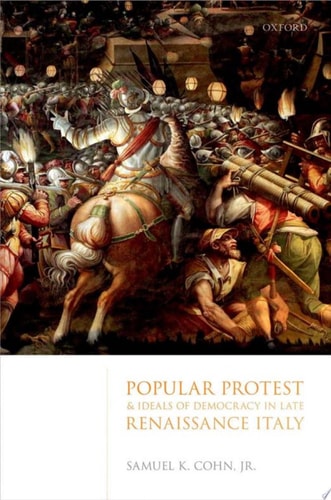
Popular Protest and Ideals of Democracy in Late Renaissance Italy
0
0
As an Amazon Associate and affiliate partner, Menrva Books earns from qualifying purchases. Learn more
Author Description
Popular Protest and Ideals of Democracy in Late Renaissance Italy is the first study to analyse popular protest across the Italian peninsula and the Venetian colonies during the early modern period, 1494 to 1559. Drawing on over 100 contemporary chronicles and diaries, the fifty-eight volumes of Marin Sanudo's diplomatic dispatches, mercantile letters, and commentary, and 586 collective supplications scattered through archival sources from towns and villages in the Grand duchy of Milan, Samuel K. Cohn, Jr. places these incidents and their patterns in comparative perspectives, first with the late medieval heyday of popular revolt and then with regions north of the Alps. Cohn finds new developments during the early modern period such as an increase in women rebels, mutinies of soldiers, and new tactics of revolts such as shop closures, peaceful demonstrations of strength, and use of religious processions for discussions of tactics and strategies for obtaining logistic advantage. At the same time, these protests show convergences with the medieval Italian past, with leaders coming almost exclusively from the ranks of nonelites, religious ideology playing a surprisingly minor role, and the majority of revolts centring overwhelming in towns and cities. Finally, this study demonstrates that democracies do not just die under the duress of military occupation and growing powers of autocratic regimes. Ideals of representation and equality not only persisted; they could emerge in new forms and with greater sophistication.
Menrva's Summary
THE THESIS
This study investigates the evolution of popular protest and democratic ideals in Italy between 1494 and 1559, challenging the assumption that autocratic regimes and military occupation extinguished all forms of political representation. Samuel K. Cohn Jr., a historian specializing in late medieval and early modern social movements, utilizes a vast array of primary sources—including contemporary chronicles, diplomatic dispatches, and collective supplications—to map the shifting patterns of revolt. He argues that while certain medieval traditions persisted, the early modern period introduced novel tactics and demographics, suggesting that democratic aspirations remained resilient and adaptive under pressure.
THE SCOPE MAP
What You Will Find
- Analysis of popular protest across the Italian peninsula and Venetian colonies from 1494 to 1559.
- Examination of new protest tactics including shop closures, peaceful demonstrations, and the strategic use of religious processions.
- Comparative data contrasting Italian revolts with late medieval precedents and contemporaneous movements north of the Alps.
Scope Limits
- The study focuses primarily on urban centers and specific archival collections, potentially limiting insights into rural or non-documented regions.
- The analysis is bounded by the specific timeframe of 1494 to 1559, excluding later developments in the seventeenth century.
THE AUTHORITY PERSPECTIVE
Scholars recognize this work as a significant contribution to the social history of the Italian Renaissance, particularly for its rigorous use of archival evidence and its challenge to traditional narratives of political decline. Readers frequently note the academic density of the prose, which is tailored for historians and students of early modern political structures.
Page Count:
272
Publication Date:
2022-03-30
Publisher:
Oxford University Press
ISBN-10:
0192849476
ISBN-13:
9780192849472
History
Social History
European History
Sociology
Community Tags
Similar Books