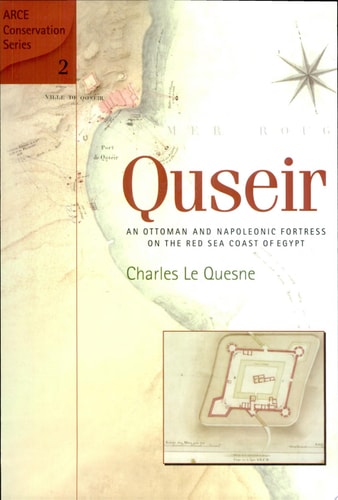
Quseir: An Ottoman and Napoleonic Fortress on the Red Sea Coast of Egypt
0
0
As an Amazon Associate and affiliate partner, Menrva Books earns from qualifying purchases. Learn more
Author Description
This volume presents the results of recent archaeological and historical studies of the Ottoman fort of Quseir, which was Upper Egypt's only direct outlet to the Red Sea at that time. Illustrated with over 100 maps, drawings, and photographs, this groundbreaking study examines a key example of Ottoman-era material culture in Egypt. With contributions from seven historians and archaeologists, Quseir traces the development and history of an important Ottoman fortress, built near an abandoned medieval port. Its establishment was part of a constant struggle by the Ottoman state to maintain control of the desert and the routes across it. Studies of the archaeological remains from the fort reveal the presence of reused stones from a Greco-Roman temple and emphasize its key role as a regional grain entrepôt and port of embarkation for Muslim pilgrims on the way to Mecca. Quseir is a portrait of a place at the boundary of two powerful cultural and economic systems. While serving as an outlet for the pilgrims and produce of Upper Egypt, Quseir also played a role in the distinctive maritime culture of the Red Sea. This study also reveals in detail for the first time the story of the struggle between the British and French for control of Quseir during the Napoleonic occupation of 1798-1801. American Research Center in Egypt Conservation Series 2
Menrva's Summary
THE THESIS
This volume presents the results of recent archaeological and historical studies of the Ottoman fort of Quseir, which was Upper Egypt's only direct outlet to the Red Sea at that time. Illustrated with over 100 maps, drawings, and photographs, this study examines a key example of Ottoman-era material culture in Egypt. With contributions from seven historians and archaeologists, Quseir traces the development and history of an important Ottoman fortress, built near an abandoned medieval port, as part of the Ottoman state's struggle to maintain control of the desert and its routes. Studies of the archaeological remains reveal reused stones from a Greco-Roman temple and emphasize its key role as a regional grain entrepôt and port of embarkation for Muslim pilgrims.
THE SCOPE MAP
- Archaeological and historical studies of the Ottoman fort of Quseir.
- Examination of Ottoman-era material culture in Egypt.
- Detailed history of the fortress's development and its role in Ottoman state control.
- Analysis of archaeological remains, including reused Greco-Roman stones.
- Exploration of Quseir's function as a grain entrepôt and pilgrim embarkation point.
- Account of the struggle between the British and French for control during the Napoleonic occupation.
- Discussion of Quseir's place at the boundary of powerful cultural and economic systems and its role in Red Sea maritime culture.
THE AUTHORITY PERSPECTIVE
This study is presented as a comprehensive examination of the Ottoman fort of Quseir, drawing on recent archaeological and historical research. The work highlights the fort's strategic importance as Upper Egypt's sole Red Sea outlet and its role in Ottoman efforts to control desert routes. It details the fort's construction, archaeological findings including reused ancient materials, and its function as a vital port for trade and pilgrimage. The book also covers the specific conflict over Quseir during the Napoleonic Wars, positioning it as a nexus of cultural and economic exchange.
Page Count:
362
Publication Date:
2007-01-01
Publisher:
American Univ in Cairo Press
ISBN-10:
9774160096
ISBN-13:
9789774160097
History
Non-Fiction
Military History
Ottoman Empire
Egypt
Archaeology
Community Tags
Similar Books