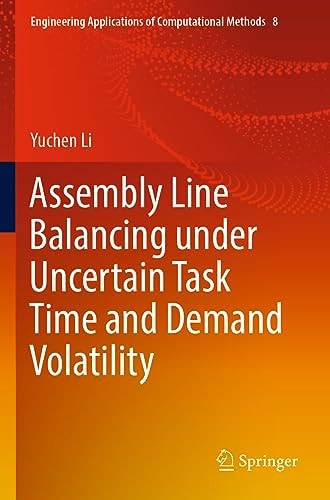
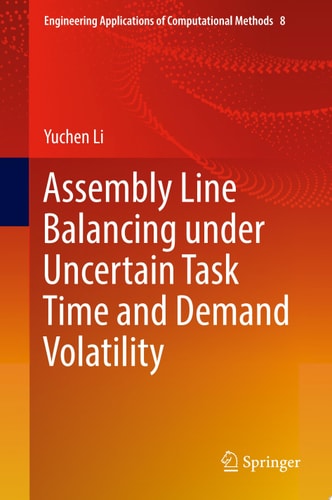
Assembly Line Balancing under Uncertain Task Time and Demand Volatility
0
0
As an Amazon Associate and affiliate partner, Menrva Books earns from qualifying purchases. Learn more
Author Description
This book introduces several mathematical models in assembly line balancing based on stochastic programming and develops exact and heuristic methods to solve them. An assembly line system is a manufacturing process in which parts are added in sequence from workstation to workstation until the final assembly is produced. In an assembly line balancing problem, tasks belonging to different product models are allocated to workstations according to their processing times and precedence relationships among tasks. It incorporates two features, uncertain task times, and demand volatility, separately and simultaneously, into the conventional assembly line balancing model. A real-life case study related to the mask production during the COVID-19 pandemic is presented to illustrate the application of the proposed framework and methodology. The book is intended for graduate students who are interested in combinatorial optimizations in manufacturing with uncertain input.
Menrva's Summary
THE THESIS
This book addresses the complex challenge of balancing assembly lines when task times are uncertain and demand fluctuates. The author, Yuchen Li, presents mathematical models based on stochastic programming to tackle these issues, developing both exact and heuristic solution methods. The work incorporates uncertain task times and demand volatility, both individually and in combination, into traditional assembly line balancing models. A case study from mask production during the COVID-19 pandemic demonstrates the practical application of the proposed framework.
THE SCOPE MAP
- Introduction to assembly line systems and the assembly line balancing problem.
- Mathematical models for assembly line balancing using stochastic programming.
- Development of exact and heuristic methods for solving these models.
- Incorporation of uncertain task times into assembly line balancing.
- Integration of demand volatility into assembly line balancing.
- Simultaneous consideration of uncertain task times and demand volatility.
- Application of a real-life case study from mask production during the COVID-19 pandemic.
- Discussion of combinatorial optimizations in manufacturing under uncertainty.
THE AUTHORITY PERSPECTIVE
The book is designed for graduate students specializing in combinatorial optimization within manufacturing, particularly those dealing with uncertain inputs. The inclusion of stochastic programming and the focus on both uncertain task times and demand volatility suggest a rigorous, academic approach. The practical application through a COVID-19 mask production case study indicates an effort to bridge theoretical models with real-world manufacturing challenges. The methodology presented is likely to appeal to researchers and practitioners seeking advanced techniques for optimizing assembly line operations.
Page Count:
152
Publication Date:
2023-09-12
Publisher:
Springer Nature Singapore
ISBN-10:
981194217X
ISBN-13:
9789811942174
Science & Technology
Non-Fiction
Operations Research
Manufacturing
Optimization
Community Tags
Other Editions(3)

Similar Books