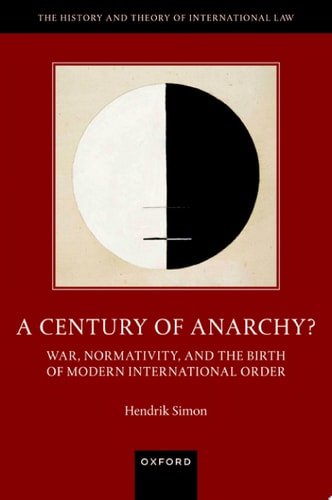
A Century of Anarchy?: War, Normativity, and the Birth of Modern International Order
0
0
As an Amazon Associate and affiliate partner, Menrva Books earns from qualifying purchases. Learn more
Author Description
The nineteenth century has been understood as an age in which states could wage war against each other if they deemed it politically necessary. According to this narrative, it was not until the establishment of the League of Nations, the Kellogg-Briand Pact, and the UN Charter that the 'free right to go to war' (liberum ius ad bellum) was gradually outlawed. Better times dawned as this anarchy of waging war ended, resulting in radical transformations of international law and politics.However, as a 'free right to go to war' has never been empirically proven, this story of progress is puzzling. In A Century of Anarchy?: War, Normativity, and the Birth of Modern International Order, Hendrik Simon challenges this narrative by outlining a genealogy of modern war justifications and drawing on scientific, political, and public discourses. He argues that liberum ius ad bellum is an invention created by realist legal scholars in Imperial Germany who argued against the mainstream of European liberalism and, paradoxically, that the now forgotten Sonderweg reading was universalized in international historiographies after the World Wars.A Century of Anarchy? is a compelling read for historians, jurists, political theorists, international relations scholars, and anyone interested in understanding the emergence of the modern international order. In this groundbreaking work, Simon not only artfully deconstructs the myth of liberum ius ad bellum but also traces the political and theoretical roots of the modern prohibition of war to the long nineteenth century (1789-1918).
Menrva's Summary
THE THESIS
Hendrik Simon investigates the historical validity of the 'free right to go to war' (liberum ius ad bellum) and argues that it is a constructed myth rather than an empirical reality of nineteenth-century international relations. Drawing on extensive archival research and discourse analysis, Simon, a scholar of international relations and legal history, challenges the conventional narrative that modern international order only emerged after the World Wars. He posits that the concept of a 'free right to war' was an invention of Imperial German legal scholars, which was subsequently universalized in international historiography to frame the development of modern legal prohibitions.
THE SCOPE MAP
What You Will Find
- A genealogy of war justifications spanning the long nineteenth century from 1789 to 1918.
- An analysis of Imperial German legal realism and its influence on international law.
- A critique of the 'Sonderweg' reading of European history in the context of international order.
Scope Limits
- The study focuses primarily on European intellectual and legal history rather than global or non-Western perspectives on war.
- The work does not provide a comprehensive history of all international treaties, focusing instead on the discourse surrounding the right to wage war.
THE AUTHORITY PERSPECTIVE
Scholars in the fields of international law and political theory recognize this work as a significant revisionist contribution to the history of international order. Readers frequently note the academic density of the prose, which requires a strong background in legal theory and historical methodology to fully appreciate the author's deconstruction of established historiographical myths.
Page Count:
408
Publication Date:
2024-01-01
Publisher:
Oxford University Press
ISBN-10:
0192855506
ISBN-13:
9780192855503
History
International relations
European History
Specialties
Legal Theory
International Law
Community Tags
Similar Books