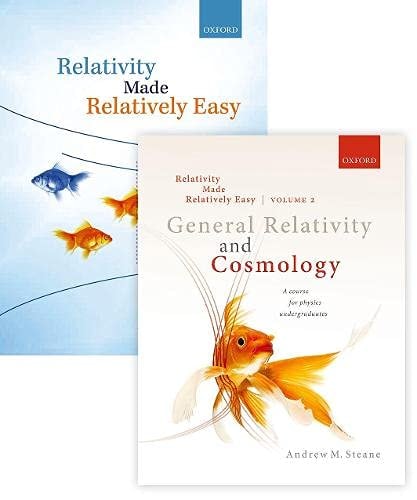
Relativity Made Relatively Easy: Volumes 1 and 2
0
0
As an Amazon Associate and affiliate partner, Menrva Books earns from qualifying purchases. Learn more
Author Description
The two-volume book Relativity Made Relatively Easy provides a comprehensive and detailed account of the physics of Relativity. Volume 1, which was published in 2012, is devoted to covering the basics of the theory of Special Relativity, assuming almost no prior knowledge, making it suitable for undergraduates studying the subject.Volume 2 encourages students to take their learning further by providing a working understanding of astronomy and gravitational waves, as well as introducing the reader to the key concepts in cosmology and classical field theory. Beginning with a survey of the main ideas, the text goes on to give the methodological foundations (linearized approximation, differential geometry, covariant differentiation, physics in curved spacetime). It covers the generic properties of horizons and black holes, including Hawking radiation, introduces the key concepts in cosmology and gives a grounding in classical field theory, including spinors and the Dirac equation, and a Lagrangian approach to General Relativity.The book is suitable for self-study and is aimed throughout at clarity, physical insight, and simplicity, presenting explanations and derivations in full, and providing many explicit examples.
Menrva's Summary
THE THESIS
This two-volume set investigates the fundamental principles of special and general relativity to provide a comprehensive pedagogical framework for students and independent learners. Prof. Andrew Steane, a physicist with extensive academic experience, utilizes a structured approach that prioritizes physical intuition and mathematical clarity. By moving from foundational concepts to advanced topics like black hole physics and cosmology, the text aims to bridge the gap between undergraduate physics and professional research methodologies.
THE SCOPE MAP
What You Will Find
- Comprehensive coverage of Special Relativity including kinematics and dynamics.
- Methodological foundations of General Relativity such as differential geometry and covariant differentiation.
- Advanced topics including Hawking radiation, spinors, the Dirac equation, and Lagrangian mechanics.
- Explicit derivations and worked examples designed for self-study.
Scope Limits
- The text assumes a baseline level of undergraduate physics knowledge for the second volume.
- It does not focus on experimental history or the philosophical implications of relativity beyond the physical theory.
THE AUTHORITY PERSPECTIVE
Experts and students frequently highlight this work as a highly accessible resource for those seeking a rigorous yet clear introduction to complex gravitational theories. The academic community values the text for its balance of conceptual explanation and mathematical detail, making it a standard reference for self-study in the field.
Page Count:
960
Publication Date:
2022-01-28
Publisher:
Oxford University Press
ISBN-10:
0192856790
ISBN-13:
9780192856791
Science
Physics
Cosmology
textbook
Relativity
Astrophysics
Community Tags
Similar Books