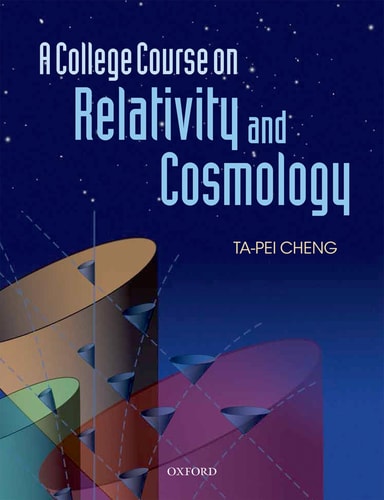
A College Course on Relativity and Cosmology
0
0
As an Amazon Associate and affiliate partner, Menrva Books earns from qualifying purchases. Learn more
Author Description
This advanced undergraduate text introduces Einstein's general theory of relativity. The topics covered include geometric formulation of special relativity, the principle of equivalence, Einstein's field equation and its spherical-symmetric solution, as well as cosmology. An emphasis is placed on physical examples and simple applications without the full tensor apparatus. It begins by examining the physics of the equivalence principle and looks at how it inspired Einstein's idea of curved spacetime as the gravitational field. At a more mathematically accessible level, it provides a metric description of a warped space, allowing the reader to study many interesting phenomena such as gravitational time dilation, GPS operation, light deflection, precession of Mercury's perihelion, and black holes. Numerous modern topics in cosmology are discussed from primordial inflation and cosmic microwave background to the dark energy that propels an accelerating universe.Building on Cheng's previous book, 'Relativity, Gravitation and Cosmology: A Basic Introduction', this text has been tailored to the advanced student. It concentrates on the core elements of the subject making it suitable for a one-semester course at the undergraduate level. It can also serve as an accessible introduction of general relativity and cosmology for those readers who want to study the subject on their own. The proper tensor formulation of Einstein's field equation is presented in an appendix chapter for those wishing to glimpse further at the mathematical details.To request a copy of the Solutions Manual, visit http://global.oup.com/uk/academic/physics/admin/solutions.
Menrva's Summary
THE THESIS
This text investigates the core principles of Einstein's general theory of relativity and modern cosmology through an accessible, physically-oriented framework. Author Ta-Pei Cheng, a physicist, utilizes a pedagogical approach that prioritizes physical intuition and practical applications over the exhaustive use of tensor calculus. By focusing on the metric description of curved spacetime, the book provides students with the tools to analyze gravitational phenomena and cosmological evolution within a single-semester curriculum.
THE SCOPE MAP
What You Will Find
- Geometric formulation of special relativity and the principle of equivalence.
- Metric-based analysis of gravitational time dilation, light deflection, and black holes.
- Modern cosmological topics including primordial inflation, cosmic microwave background, and dark energy.
- A supplementary appendix providing the formal tensor representation of Einstein's field equations.
THE AUTHORITY PERSPECTIVE
Experts and educators recognize this text as a highly effective bridge for advanced undergraduates transitioning into general relativity. Readers frequently note that the book successfully balances conceptual clarity with the mathematical rigor necessary for a foundational understanding of the field.
Page Count:
292
Publication Date:
2015-08-15
Publisher:
Oxford University Press
ISBN-10:
0199693412
ISBN-13:
9780199693412
Science
Cosmology
Relativity
Physics
textbook
Academic
Community Tags
Other Editions(4)


Similar Books





Reader Comments
Share Your Thoughts
No comments yet. Be the first to share your thoughts!