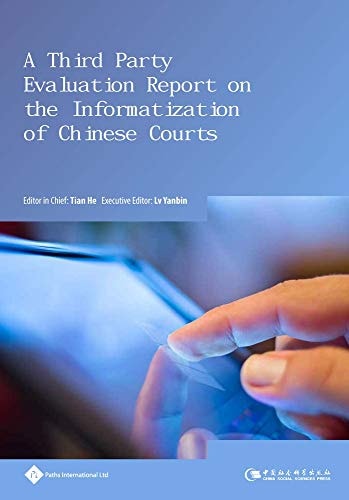
A Third Party Evaluation Report on the Informatization of Chinese Courts
0
0
As an Amazon Associate and affiliate partner, Menrva Books earns from qualifying purchases. Learn more
Author Description
Since the 1990s, global science and technology has been progressing every single day, with internet and big data having become an important orientation of the times and the most significant characteristics of the global economic society as well. Therefore promoting information development is becoming not only a top concern of the state, but a demanded work for the court. The informatization of courts is defined as an endeavor and process in which the courts take initiatives to upgrade judicial credibility and to uphold legal justice by developing and implementing various types of information systems utilizing information technology in their collection, processing, storage, sharing and exploration of all kinds of information emerging from trials for promoting judicial transparency and justice for the people to the public, and for standardizing the exercise of internal judicial power and improving both the quality and efficiency of court performance. Being an important component of the state informatization, the court informatization is undergoing a profound self-revolution within the judicial system, which is not only transforming the trial mode, but improving judicial capability and optimizing the judicial structure for the construction of an innovative trial mode. And at the same time it serves as an important means to provide better services for the public and to realize the fundamental goal of justice for the people. Therefore, the development of the court information is a key solution for the court to tackle a series of deep-level issues such as how to better achieve social fairness and justice and how to meet the judicial needs of the public in the New Era, being itself an important part of the judicial reform. Recent years have witnessed remarkable achievements in judicial transparency, justice for the people, and the betterment of trial quality and efficiency as well as the standardization of judicial administration, as a result of the great initiatives by th
Menrva's Summary
THE THESIS
This report evaluates the progress and impact of court informatization in China. The author, Yanbin Lv, examines the integration of information technology within the Chinese judicial system, focusing on how advancements like the internet and big data are transforming court operations. The report details the goals of court informatization, including enhancing judicial credibility, promoting transparency, standardizing power, and improving efficiency, all within the context of broader state informatization efforts and judicial reform.
THE SCOPE MAP
- An analysis of the historical progression of court informatization since the 1990s.
- The definition and scope of court informatization, including its role in judicial transparency and justice.
- The impact of information technology on trial modes, judicial capabilities, and judicial structure.
- The function of court informatization as a means to provide public services and achieve justice.
- Court informatization as a solution to deep-level issues in achieving social fairness and meeting public judicial needs.
- The role of court informatization within the broader context of judicial reform in China.
THE AUTHORITY PERSPECTIVE
This report offers a detailed examination of the informatization of Chinese courts, a critical aspect of judicial modernization. It frames court informatization as a significant component of state informatization, driving profound changes within the judicial system. The work highlights the dual aims of enhancing judicial transparency and efficiency while also serving as a mechanism for public service and the realization of justice.
Page Count:
120
Publication Date:
2019-01-01
Publisher:
Paths International Limited
ISBN-10:
184464555X
ISBN-13:
9781844645558
Non-Fiction
Politics
Science & Technology
Court Administration
Government
Legal System
Technology
Law
Community Tags
Similar Books